ATTENTION, READERS in the 28 EUROPEAN VAT COUNTRIES: Because of the new VAT law, you probably can't order books direct from my site now. But that's okay -- just go to my Smashwords author page. You can order PDFs (as well as all the other ebook formats) from there.
Ironically, he wants you to hit more balls from the rough.
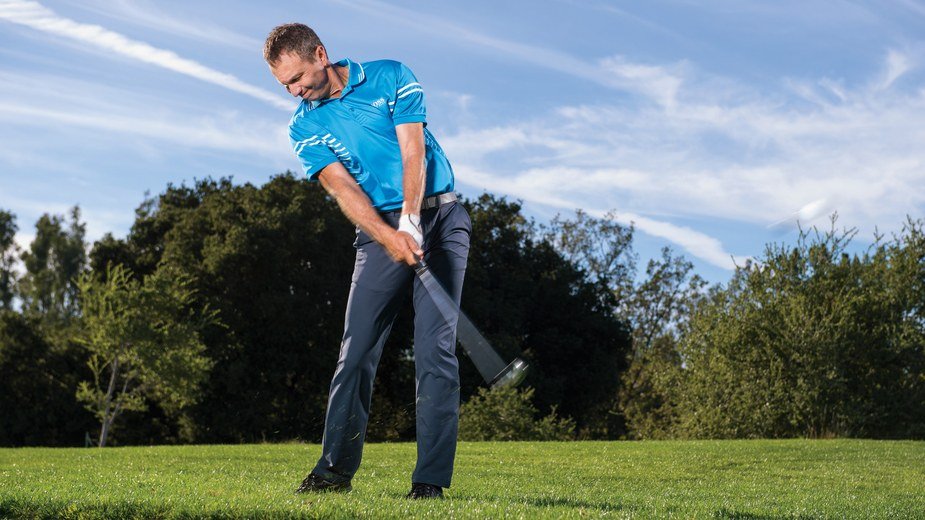
Here's the deal: Zander says most players don't stabilize their clubs enough at impact. It's a balancing act, after all -- you want to remain relaxed enough to let the club swing easily, yet not so relaxed that the club can be knocked off-line or stopped by the ground.
His solution is to practice hitting half-shots from the rough, since that will make you automatically firm up your grip at impact:
Here’s a tip to help you get the most out of hitting balls from rough.
Zander says that you need to get that feeling of connectedness between
your arms and your torso to hit solid shots. To practice that, he says,
“At address, feel pressure in both armpits, the biceps pressed against
the chest. As a drill, tuck the sleeves of your shirt under your arms
and practice making half swings, keeping that pinch.”
Zander says this will give you immediate feedback if you're not making a firm, decisive swing at the ball. Then, all you do is try to recreate the feeling when you make a full swing. Makes sense to me!
The article is short but the advice is easy to use. Best of all, you can use this drill even during a round if you feel the need to refresh your memory about how your swing should feel. That kind of drill is a win-win situation for any player!
If you follow this blog, you know I'm a big believer in staying relaxed when you swing. Here's another way to approach it, this one courtesy of Golf Channel Academy Lead Coach Charlie King:
Any martial artist worth his black belt will tell you that relaxed muscles can move oh so much faster than stiff ones. (Good martial arts instructors teach their students not to tense their muscles until an instant before impact, in order to properly convert that speed into a powerful strike.) Charlie's image of a rag doll swinging a club is a good one to help you reach that ideal.
And like a good martial artist, you'll want to tighten your grip a bit at impact. Most people do that instinctively.
Let me answer a question that I suspect many of you -- especially Hogan devotees, but anyone who tries to maintain connection during their swing (and yes, I am in that second group) -- are probably wondering about. How do you maintain connection during your swing if you're trying to stay relaxed?
Simply put, it's just a matter of practice. Martial artists practice tightening some muscles while loosening others; it just takes a little time. You can do the same thing with simple exercises like holding your club and keeping your grip tight while trying to consciously trying to relax your shoulders and arms. That's a drill you can do while sitting in a chair and watching TV. It won't take as long as you think.
Then just try swinging the club with your grip, arms and shoulders relaxed while maintaining connection between your upper arms and chest. Start with half swings and gradually stretch them out to three-quarter swings. (The arms and chest always separate slightly at the top, then reconnect onthe way down. That's just basic Hogan.) Don't worry about hitting balls; you're just trying to get used to controlling the tension during your swing.
Again, it's just a matter of practice and it will come more quickly than you expect.
Before long, you'll be able to take it out to the course and hit drivers; you'll probably gain some distance in the process. And if you practice that hand tightening - shoulder relaxing drill enough, you'll get where you can do it with irons and wedges as well. When you do, your touch around the greens will improve tremendously.
Martin says the key to improved pitching is solid contact. (Of course, that makes a world of difference in just about any golf shot!) You may have seen this drill before -- some of the Tour pros like Martin Kaymer use it on the range.
Please note that you don't have to use a ball for this drill. A stiff piece of foam will work, as will a balloon or a cloth bag stuffed full of rags. The idea is simply to maintain the 'Y' formed by your club, hands and forearms as you swing, and anything that lets you do that is fine.
What this drill does is teach you to swing your hands, arms and shoulders as a unit, rather than flipping the club with your hands and wrists. As Sara says, "connection" is one term that is frequently used for this. If you think about it for a minute, what this drill teaches you is that you've probably got too many moving parts in your swing. A pitching stroke is a very simple motion. Don't try so hard to hit the ball; learn how to swing the club smoothly and your pitching will improve.
And here's one quick tip:You'll make faster progress if you learn to relax your arms and shoulders as you swing. Tense muscles usually create jerky swings.
Have fun with this drill. I like drills that actually let you duplicate the entire motion of a swing rather than just learn a position. If you can hit solid pitches with this drill, it will translate directly to the course.
In the second post in this series I looked at how a connected modern swing built on a knowledge of how your body works eliminates the need to twist your forearms in the modern golf swing. (As a quick summary, the rotation of your lead shoulder while connected takes care of all the motion necessary to get your club face on plane, and does it pretty much automatically.) But it creates an even simpler motion in a classic-style swing, and that's what we're looking at today.
I say a 'classic-style swing' instead of just a classic swing because there are a number of swing variations being taught these days, both classic-style and modern-style. Some of these variations are starting to blur the differences between the two and, in my opinion, are better than either of the originals. Many of the old swing thoughts that clearly belonged to one original swing type or the other are not so clear anymore.
Let's look at the originals and then how they've evolved.
The original classic swing developed during the age of hickory, back when shafts couldn't take much stress before they flexed out of control. I think that's why two-plane swings originally developed -- the looping action at the top minimized the stress during the change of direction. Too much leg action created even more stress, so the focus was on the arm action -- the legs were often described as just "moving beneath" the player, as supports rather than power sources. Because of this, players often turned their hips a lot on the backswing.
The club was swung back and up, then looped down and around to create a path from the inside. (Typical swing thought: Pull down and ring the bell.) In order to make room for this inside path, the hips needed to move toward the target. (Typical swing thought: Slide your hips forward.) To facilitate a free-swinging arm action, the arms remained unconnected and players often didn't think much about proper leg action -- which often resulted in an over-the-top swing.
The classic swing evolved a bit when steel shafts took over, eliminating much of the looping at the top. Colin Montgomerie is a good example of that classic swing. There's not a lot of worry about bracing his trailing knee, and all of his hip action and arm swing look very loose and relaxed compared to the modern swing. The classic swing is typically an upright swing, with the hands carried very high.
In contrast, the original modern swing -- also a two-plane swing -- developed after steel shafts took over. Hogan's new connection technique was the real revolution here and, since the legs became the main power source and the arms were clearly the weakest link in the chain (hence connection, to help brace them), it lent itself to making a flatter swing.
At the top of the backswing, the legs drove hard toward the target and loaded the shaft. This motion dropped the hands to a lower inside plane but, since now the legs had to start the turn as well as get the hips out of the way of the inside path, the swing required a more complex lower body movement. (Typical swing thought: Bump and turn.) The trailing leg had to be braced in order to start the downswing with a forceful move, and the hands went around rather than up and down. Ben Hogan is the original, of course.
For a long time instructors said you couldn't combine techniques from these two swings. But once people believe that something can't be done, it generally doesn't take long before someone figures out how to do it. Various versions of what we now call the one-plane swing were born.
And connection was the key. You see, with the upper arms connected to the chest during the downswing, the hips no longer got in the way. Now the hips only needed to move enough to create a good weight shift. And because of that, instructors found lots of new ways to blend the two swing methods. For just a couple of examples:
Teachers like Jimmy Ballard continued to focus on the leg action but added enough arm power to keep the back straighter. This not only created a more natural throwing motion (remember my own swing thoughts about throwing Frisbees™ and hitting tennis backhands) but relieved some of the back stress caused by all that hip sliding and twisting. Like the original modern swing, this one is flatter and much more around.
Likewise, teachers like Pete Cowen continued to focus on the arm action but added more leg drive to create more club head speed. Like the original classic swing, this one is much more upright and therefore more up and down. This is the one I want to focus on.
In fact, I wouldn't be surprised if many of you are using some combination of the two already without being aware of it. If you're having a lot of trouble with your swing, that could be the reason -- a bad combination of classic and modern swing techniques. The fact is, most instructors don't tell you which method they're using -- some of them may not even know themselves, they just know their swing method works. Unless you've taken lessons from a single teacher, you could have patched together some bits and pieces that weren't meant to be patched. (The method I use in Stop Coming Over-the-Top and in any of my posts that don't say differently is similar to what Jimmy Ballard does -- primarily leg driven, but with a straighter back. I think I've mentioned that before.)
As a side note, it seems to me that the classic style is more common among the European and Asian players while the modern style is more common among American and Australian players. There are certainly exceptions -- for example, Stacy Lewis appears to have more of a classic swing while Graeme McDowell is more modern -- but overall that seems to be the case.
Anyway, for the rest of this post we're going to focus on the connected classic swing. All swings have an 'up and down' component and an 'around' component. For the time being we're going to ignore the 'around' part of the connected classic swing and focus on the 'up and down' part.
In yesterday's post I included a video of Steven Bann demonstrating that you don't have to twist your forearms to get your hands 'on plane' at the top of your backswing. I summed up the connected move this way:
From your address position, with your hands basically in front of your
belly button, your straight lead arm rotates at your shoulder and rolls
up the side of your chest where your lead tricep touches it. At the same
time, your trailing elbow bends and guides your lead arm so your lead
hand finishes just outside and above your trailing shoulder.
So on the way up your hands travel at an angle from in front of your belly button to above and outside your trailing shoulder. (Of course, in an actual swing you'd be turning your shoulders around at the same time. Your hands would reach the top of your backswing when you finished coiling your shoulders.) Your trailing arm disconnects briefly at the top so you can get more height.
Wouldn't it be wonderful if we could just pull our hands straight back down to our address position in order to hit the ball? In this new connected classic swing, WE CAN!
Why couldn't we do it in the modern swing? It's because all the leg drive forces us to focus on the 'around' part of the swing. The swing is flatter so the hands don't move downward as much... and even then they're pulled down by the leg action.
In contrast, a classic swing is focused on the 'up and down' motion in the swing. Therefore, we can do more than just let our hands drop. Instead, we can actively straighten our arms to get them back down to the address position! As our connected lead arm rolls back down the side of our chest on the downswing, we just pull our trailing arm down so it reconnects... and then we straighten the elbow of our now-connected trailing arm. As our shoulders return to our address position, our hands also return to their address position almost automatically.
And to get to our finish, we just let our lead elbow bend as our shoulders continue to turn toward the target. Our trailing arm, now straight, mirrors what our lead arm did on the backswing. Our hands finish above and just outside our lead shoulder.
In other words, our arms and hands -- when viewed without our shoulders turning -- basically move in a giant V shape in front of our torso. A very simple motion indeed, as shown in the following diagram. (For you lefties out there, the sequence is A-C-A-B where C becomes the top of the backswing and B becomes the top of the finish. Except for the labels, things didn't change enough to warrant two diagrams.)
Yeah, I know -- this is a very different way of thinking about arm motion during your swing. And you have to understand that this description is specific to a connected classic swing -- it doesn't necessarily describe how the motion feels during a modern swing, for example, because of the dropping action that starts a modern swing's downswing.
I discovered this while changing my own modern swing to a more classic one, and it takes a little effort to get your mind around it. But it didn't take me long -- we're talking a matter of weeks here. And now my swing thought as I start down is simply to straighten my arms and hit the ball. You can really feel the lead arm rolling down into position!
When I first started experimenting with a classic swing, my biggest problem was finding the bottom of my swing because my trailing hand was uncocking too soon. (The classic swing is more upright, so the swing is longer.) This V-shape swing concept helped me get it straightened out.
If you want to experiment with it, I'd advise starting with slow half swings and move to slow full swings. Once you get there, the timing is extremely easy to get because the swing rhythm isn't complex -- just up and back, down and around.
But no matter whether you use a classic swing or a modern one -- an arm-powered one or a leg-powered swing -- you've got to stop twisting your forearms if you want to become more consistent in your game. Staying connected -- and letting that connection control the rotation at your lead shoulder -- is the path to more fairways and greens.
Since there's not much time left in 2013, it makes sense that my final tip should be short as well. This Golf Digest article describes a short game shot known as "straight arm pitching"... but the article also says it's becoming known as "Stricker style." It seems appropriate to end the year with a technique from the man who keeps the game so simple.
In a single sentence, it's just a chip or pitch shot that relies on connection for its consistency. You keep your wrists relaxed and both upper arms touching your chest throughout the stroke. You're hitting the shot by turning your upper body rather than relying on the little muscles in your wrists and hands. By doing this, you "keep your hands in front of you" and keep a steady distance between you and the ball... hence, you make more consistent contact.
Take a few moments to read the article. It's not something that's going to take a lot of practice to learn and, while it's not the answer to every chipping and pitching situation -- it won't help you out of deep rough, for instance -- it's certainly useful in most of the common situations you're likely to find yourself in.
And one last thought: If you're going out to celebrate the New Year tonight, leave your clubs at home. It's dangerous to drink and drive... or chip or putt, for that matter. ;-) Happy New Year!
It appears that Jason's waggle is different from Hogan's, despite Jason being a real Hogan fanatic. That fact has become clearer to me since I wrote the post on Hogan's waggle mentioned above. There are two distinct methods of waggling:
a method that uses the entire arm (Hogan's)
a method that focuses on the wrists (Dufner's)
If you were watching Morning Drive on Monday, you heard Charlie Rymer describing the second one. It's the simpler way to do it.
Here's a Swing Fix show that Michael Breed did right after Jason got his first Tour win in 2012. (Yes, the entire show. It was only a half-hour long back then -- without commercials, just over 21 minutes.) The first 6 minutes are about waggling.
And here's a brief description of Hogan's waggle from Five Lessons. I've edited it slightly, as Hogan wrote for right-handers and I know many of you are lefties; I've substituted the terms lead and trailing for left and right. Also, a large part of this is in ALL CAPS in the book, but it's easier to read in regular print:
In the waggle, the lead hand is the controlling hand. The trailing works along with the lead. Each time you waggle the club back, the trailing elbow should hit the front part of your trailing hip, just about where your watch pocket is. When this takes place, the lead elbow, as it must, comes out slightly, the lower part of the arm from the elbow down rotates a little, and the lead hand moves three inches or so past the ball toward the target. As the hands move back to the ball on the forward waggle, the lead hand also moves an inch or two past the ball toward the target. During the waggle, the upper part of the arms remain rooted against the sides of the chest. As we stated earlier, there should be no turning of the shoulders. (p66-67)
In the Hogan waggle, there's a BIG movement and a LITTLE movement, and they alternate. (That's why he mentions a 3-inch move and a 1-inch move of the lead hand.) The trailing hand doesn't move from side to side -- the lead hand does all the moving and the trailing hand just turns. In addition -- and this is a big difference from Dufner's waggle -- the trailing elbow moves back and bumps the trailing hip, then returns to its setup position. At the same time, the lead elbow moves away from your body, then returns to its setup position.
In both types of waggle, the hands stay in roughly the same spot in front of your body. The head of the club does most of the noticeable moving. One other thing the two types of waggle have in common: Jason says he has no set way to waggle, and Hogan says you shouldn't try to "groove" your waggle. The idea is that waggles just happen and help reduce tension.
Hopefully this will clear up any confusion the TV discussions of Dufner's waggle might have caused you.
Inbee Park is proof that you don't need a spectacular, awe-inspiring swing to rip your opponents to shreds. A couple of days ago I discovered I hadn't done a post on her -- and was surprised that I hadn't, to be blunt -- so her second major is a good reason to correct that little oversight!
Looking at Inbee's stats, you might be surprised that she plays so well. She averages just over 245 off the tee, only 62nd on Tour and not that long for a 5'6" woman. She hits 70% of her fairways -- better than my Rule of 67, but only 71st among the ladies -- and 71% of her GIR, which puts her at a slightly better 39th on Tour. Doesn't sound so hot, does it?
But she's 6th on Tour in putts per round (28.45) and 2nd in scoring average (70). I'm sure all of you are thinking about those long putts she sank at the Kraft Nabisco, but there's more going on here than that. That 70 average means she averages 2-under each round she plays... but she putts well enough to be 5- to 8-under each round. She simply doesn't 3-putt very often and when she misses the green, she gets up and down more times than not. It's been enough to get her two wins this year, and one of those is a major.
This video from around a year ago shows her swing face-on. Notice how good her basics are -- a one-piece takeaway, which means she's connected to start her swing; she stays connected and doesn't sway on the way back; she stays centered between her feet as she starts down (that is, there's no huge hip slide toward the target), and she finishes nice and balanced. Her swing doesn't even look that powerful, does it? But it's consistent and repeatable.
What I'd really like to talk about is the "pause" at the top of her swing that many commentators point out. In this slo-mo it's pretty clear that she doesn't really stop, but it's not really obvious why it looks that way at full speed. Here's another video from about a month ago that shows exactly what's happening.
As the slo-mo gets slower and slower, you can see what's going on very clearly. At the top of her backswing, the head of her club actually travels backward and parallel to the ground! Instructors often refer to this as "laying off" the club, and a lot of power hitters like Sergio use the move to increase their wrist cock during their downswing. But those players generally have flatter swings, and that's not what Inbee is doing here.
You probably heard several times this past weekend how upright Inbee's swing is. (It's not as upright as Thaworn Wirantchant's, but it's not far off.) The key here is her trailing elbow. If you watch the progressively slower downswings -- especially the 3rd one -- you can see that she's actually twisting her elbow away from her body as she hits the ball! I suspect she had trouble with a push at some time in the past (meaning her swing comes from the inside much more than she'd like) so she started trying to square the club up better during her downswing. But since she probably wasn't strong enough to twist her forearms the way a lot of the men do, she ended up twisting her entire arm.
Normally that wouldn't be a particularly accurate move -- and I certainly wouldn't recommend it -- but Inbee does the motion with her upper arm rather than her forearms. As a result, she's controlling the move with the large muscles of her trailing shoulder rather than the smaller twitchy muscles of her wrists. That's part of the reason why she's able to be fairly consistent with such an unorthodox move.
But the biggest reason is that so much of her swing is fundamentally solid, that one unorthodox move doesn't wreck her swing. Swings don't have to be perfect to work well; they just have to be dependable... and that describes Inbee Park's swing to a T.
I love it when one of the big name instructors -- in this case, Michael Breed -- recommends swinging the way I teach!
On Monday night's Golf Fix Michael showed a drill that he calls "Wide to Narrow." Fortunately, there's a clip showing the drill on GC's website. Here it is:
In this clip Michael demonstrates several of the things I frequently talk about here on the blog and in my books, like connection, the one-piece takeaway, delayed wrist set, and delayed wrist cock. This drill is a good way to teach you how wrist cock gets "held" until late in the swing.
Here's a tip that Michael doesn't give you: That "flicking motion" he mentions is largely caused by your trailing elbow. Note that, if you make a one-piece takeaway on the way back, your trailing elbow is straight -- that's the wide part of the drill. Then you start your downswing by bending your trailing elbow so it's close to your side -- that's the narrow part. If your lead elbow stays straight and your trailing elbow bends, it will cause your wrists to cock. If you keep your grip too tight, you'll interfere with that cocking action.
For most of you it's going to feel weird. That's because you're doing the incorrect "narrow to wide" move he talks about. (That's called casting, btw.) You may find that you have to make a slower change of direction in order to keep this "flicking" under control. That's why many pros appear to have a pause in their swing.
I found this video over at golftipsmag.com and I think it has some value for helping you improve your swing -- especially when you can't get to the range to practice.
PGA teaching pro Dan Martin has this tip about swinging in slow motion. I mean S-L-O-W M-O-T-I-O-N, or even slower than that! Here, let him explain it:
I don't think you want to go overboard with this, gang. Even Martin suggests no more than 5 attempts during a practice session. (And note that although he says to take 30 seconds with each swing, he isn't going nearly that slow. I suspect a 10-second swing would be just fine.) But I can see some real value to this drill.
It helps you develop your balance. If you can't keep your balance in slow motion, you're probably off-balance at full speed.
It helps your weight shift. This is part of your balance. It looks to me like it could help prevent those unwanted hip slides and spine tilts some of you are fighting.
It's a good way to work on the sequence of your swing, especially when you start your downswing. I agree with him that the change of direction is seriously de-emphasized lately. Making a slow downswing is a good way to learn the proper elbow action that helps you create more swing speed late in the downswing.
The primary value is that it slows your swing down enough that you can learn what your entire swing feels like, especially those parts that zip by so fast that you don't even pay attention to them.
It's not about over-analyzing your swing; rather, it's about getting a good overall sense of what feels right. You want to get to the point where, when your swing doesn't feel good, you can say "it doesn't feel right at THIS point in my swing." Even if you don't know exactly what's wrong, you've made it much easier to get yourself back on track.
So give it a try. You can do it in your backyard -- maybe even your basement if the ceiling is high enough -- and learn what your swing should feel like. And as you become more familiar with the proper feel, it should be easier to swing at full speed out on the course.
In the comments to Sunday's post Ramzi left me a question about which arm controls the downswing. I wrote a reply but afterward I thought about an older post that might also be helpful.
What Nick is talking about here in relation to chipping and pitching also applies to the full swing. And it's usually easier to learn full swing moves if you start by using the techniques for pitching.
Connection is the key to keeping your arms in synch with the rest of your body. By all means, try out this little drill!
I found this Golf Digest tip video based on some instruction from Mike Bender. It's on that somewhat confusing technique where you hit a fade using an in-to-out swing -- the method most of us think of as a hook move:
The video is pretty self-explanatory. I'd just like to point out that, while the swing path is in-to-out relative to your foot line, it's still out-to-in relative to your aim line. In other words, you actually aim farther to the left (for a right-hander -- a left-hander aims farther to the right) for this shot to make sure the club head still travels across your aim line.
This is part of the reason I think Ben Hogan developed the idea of connection. It helped him get this in-to-out swing path at all times. (I have several posts on connection, but the link sends you to a post with a video of Nick Faldo demonstrating the technique. This link shows Jimmy Ballard demonstrating it, but Ballard is only connecting the lead arm in his video.)
Hopefully this will help you become more consistent at hitting a power fade.
Ramzi left me a couple of questions in the comments to my "hot and sticky" post a couple of days ago after he went to watch the final round of the CIMB Classic. (Yes, Ramzi lives in Malaysia.) One of those questions concerned Jason Dufner's waggle, and I said I'd just do a post so I could cover it properly.
Here was his comment about Jason:
I also saw Dufner and saw the famous waggle - but major question here is
the swing supposed to be wristy like his waggle? It takes a lot of
confidence to start the swing after the waggle, I must say.
Lots of instructors talk about "liking the waggle" but they don't talk much about the details of how to do it. And make no mistake, Ben Hogan liked details. First, here's what I wrote in the comments about the waggle, since it will save us some time:
First, the swing should NOT be wristy like the waggle. Hogan was pretty clear in his book Five Lessons:
The hands and arms shouldn't do anything during the swing but hang on
to the club. The trick with a Hogan-style waggle as described on pages
66 and 67 of my copy -- and this isn't made clear most of the time -- is
that the waggle is a specific set of moves, but it isn't identical each
time. I'll do a post about it for Tuesday.
The waggle, according to Hogan, is a bridge between address and the actual swing. It's not just about loosening up, but about practicing (1) the path back, (2) squaring up the club face at contact, and (3) visualizing the shot. But the waggle is very different from the actual swing you're going to make in several ways. Hogan mentions that there is no shoulder turn; that in itself keeps the waggle from being exactly like your backswing.
But there's a specific technique to Hogan's waggle. Most people just twist their forearms, but not Hogan. The upper arms stay connected to the chest, as in a one-piece takeaway, but the lead elbow moves a couple of inches straight away from your body while the trailing elbow moves closer to your side... then they move back to their start position. The hands stay relaxed and just keep hold of the club. This isn't forearm twisting!
The bending of the elbows of what causes the apparent rotation of the forearms; the real rotation actually happens at the lead shoulder. I know that sounds kinda weird, but remember that your upper arms are touching your chest lightly. Hogan was very specific about this:
During the waggle, the upper part of the arms remain rooted against the sides of the chest. As we stated earlier, there should be no turning of the shoulders. (Five Lessons, p67)
If you do your waggle the way Hogan says, your upper arm actually rolls up the side of your chest. If you try it, you'll see it makes perfect sense.
This means that the waggle is actually an upper arm movement, not a wrist movement. The hands and wrists stay relaxed. And it assumes you're using Hogan's concept of connection in your swing. If you aren't, the Hogan-style waggle has questionable effectiveness.
As for Ramzi's comment that "it takes a lot of
confidence to start the swing after the waggle," there's more truth to that than you might think. Hogan specifically says, in all caps, "DON'T GROOVE YOUR WAGGLE" (p67). Modern players try to create a ritual that repeats exactly the same way on every shot. You may remember that Dufner received some criticism for not waggling the same way every time. (In fact, Jason said he just waggles until he feels ready to swing.) But that's exactly how Hogan said to do it. And if every waggle feels a little different, you won't feel the same way each time... although Hogan says that, after his waggle, he often felt that he had rehearsed the swing exactly the way he wanted to play it.
If you're really interested in learning a Hogan-style waggle, the thing to do is get a copy of Hogan's Five Lessons: The Modern Fundamentals of Golf. For what it's worth, it's a fairly small paperback that retails for around 13 bucks. (You can probably find it cheaper online.) But Hogan is the expert when it comes to the waggle; in my opinion, if you want to learn how to do it right, you should go to the source.
And there you have it -- the basics of Hogan-style waggling. Simply put, if you want to swing like Jason Dufner, you may want to incorporate it into your swing. If you don't swing like Jason, it's not critical to making a good swing.
Wow, you came back! You must be serious about not pushing that ball!
A quick note, just to make sure we're all on the same page:
Rather than try to use left and right all the time when I have both
left-handers and right-handers reading this, I simply use the terms lead and trailing.
If you're left-handed, your left side is your trailing side; if you're
right-handed, your right side is your trailing side -- and obviously
your other side is your lead side. Got that? Good. Let's move on.
The first two posts dealt with what I think is the most common cause of a pushed shot -- leaning backward during your downswing. Today we'll look at the other most common cause of pushes.
That problem is letting your lead elbow drift away from your body during your downswing.
It makes sense if you just think about it. When you come over-the-top, your trailing elbow gets out away from your body during your downswing. That throws the club out over your target line and you end up pulling the club back across the line toward your body, which creates a pulled shot.
In a pushed shot you do just the opposite. Your lead elbow drifts out away from your body during your downswing, so the club starts the way you wanted but then it gets farther away from your body instead of curving around it.
There are several things that can make this problem even worse:
If you're leaning backward during your downswing, that tilts your shoulders and moves your elbow away from your body even more. If you're leaning backward AND your elbow drifts away from your body, you're probably looking at a huge push-slice.
If the problem's not real bad, it might just make you "chicken-wing" your followthrough.
Since this move can also make a slice worse, it might cause you to flip your hands and you end up with a big hook. This is a problem many of the pros fight against. Sometimes this is the problem they're talking about when they say they "got stuck," and you'll see them doing things like practicing with a glove stuck in their lead armpit.
But no matter what you do, if you try to fix this problem without understanding what causes it, there's a good chance you'll be fighting a push for a long time.
If you've read my blog for any length of time, you've heard me preach about one-piece takeaways until you're sick of it. But a bad takeaway is the place where this kind of push gets started, so let me quickly explain how it happens.
Ben Hogan correctly said that your elbows should point down at the ground throughout your swing. Too many people start their backswings by twisting their forearms to the side. In addition to all the other problems this can cause (there's a full technical explanation in my book Stop Coming Over-the-Top, complete with a load of diagrams, if you're interested), twisting your forearms causes your lead elbow to point at the target instead of the ground. When you reach the top of your backswing your lead elbow is still pointed sideways instead of down, and the natural way to start your downswing from that position is to pull sideways... which will cause you to bend that lead elbow and move it away from your side.
Hogan's solution to this was something he called connection, which I've also written about on this blog. When you're connected, your upper arms rest lightly against your chest the way they did at address. Basically, Hogan said that if you kept your elbows close to your side this way during your swing -- at least when your hands are not above your shoulders, because then your trailing arm has to move away a little -- your elbows will point down at the ground all the way through your swing.
That's why pros sometimes put a glove or a towel under their lead armpit. The glove (or towel) will fall to the ground if they get "disconnected." But unless you make a correct takeaway -- a connected one-piece takeaway -- you'll have your elbow in the wrong position from the start. Then you'll be struggling to twist your arms back into position on the way down. That's just doing things the hard way... which is a shame, because this cause is the easiest to fix.
Tomorrow I'll try to wrap this all up and fill in any blanks I may have missed by tackling each problem separately -- things like why you might lean backward on the downswing and how a bent elbow can make it worse. After all, some of you may be making both mistakes at the same time!
Yeah, I know you're curious. Matt Kuchar's swing looks so flat, yet it works so consistently.
I've done posts about Matt's swing before. In 2009 I wrote a brief piece called Matt Kuchar Can “Flat-Out” Play, then added a fuller look at his swing in 2010 with It's Not Over Till the Flat Man Swings. But I have a feeling that we'll be hearing even more about him if this win is the breakthrough it appears to be, so today I'll add a new one.
This is a Golf Digest Tips Plus video about his swing. It makes a good point, but it leaves something out which I'll add after the video:
It's important to understand that your left shoulder (right shoulder if you're a lefty) moves down when you coil your shoulders, not parallel to the ground. That's true in virtually any swing you might make, not just a Kuchar copy. And the tip about being able to wiggle your toes will help you make sure your hip moves back and doesn't make a slide to the side.
But Kucher's swing is MUCH flatter than Peter Morrice is demonstrating. Here's a link to a Golf Digest swing sequence for him. The link will take you to photo #14 in the sequence, which is the top of his backswing as seen in a down-the-line view. See how much flatter his arms are than Peter's in the Golf Tips video? Matt's swing, by his own description, feels more like a baseball swing. The description on the photo may say "Classic one-planer: Left arm on the same angle as the shoulders," but you can see that his left arm is clearly WAY below his shoulders. This puts his right elbow very close to his side, which might feel cramped to some of you.
As I pointed out in my 2009 post about his swing, Kuchar is 6' 4" so this relatively flat swing plane is more like a 5' 10" player's "proper" swing. If you're shorter than Kuch, this swing will make it harder to get a steeper swing, the kind you need when you dig balls out of the rough. But if you do it right, it can be a good way to develop a draw and could be especially useful off the tee. You want to swing upward there anyway, so a flatter swing isn't a big problem.
This Tips Plus video will help you understand the basics of a good shoulder coil, which are the same for almost any swing. But if you want to give Matt's swing a try, make sure you get that low arm position correct. Matt's accuracy comes from the fact that his right elbow is so close to his side that he can't help but have a more consistent swing plane. It's an extreme application of Hogan's connection principle, but it works.
I can't guarantee that you'll win a PLAYERS trophy, though.
Today I'd just like to pass along a slice fix I found while rummaging around the Golf Digest site.
I have a belief that "mechanics inform feel, but feel creates mechanics." By that I mean that you can practice mechanics to learn how they feel, and then recreate those mechanics just by recreating the feel. So far, so good.
Here's the problem: Too many players swing by feel without some kind of yardstick to determine what their "feel" is actually doing. For example, many players twist their forearms and end up with a laid-off club on their backswing -- all because they think the feel that creates that laid-off position actually means they're on plane.
That, needless to say, causes all kinds of problems. That's why I like to compare golf swings to other common movements we all know. Those "feels" are ones that can give us the predictable results we want.
A couple of days ago Ramzi left a comment on one of the older posts. Here's part of it:
My driving sucks big time & I am never consistent in setting up. But when I hit a long one it's pretty long (for Malaysian standards).
So what would you recommend for myself who is:
1. 175cm tall or nearly 5ft 9 inches
2. Wide shouldered - I wear a 44inch jacket for my suit.
3. Weight approx. 220 pounds or 98kg
4. Due to a 'one-piece' gut, i don't have great flexibility, but I've tried my best to point my left shoulder at the ball during the backswing.
Hence, would appreciate any guidance/advice on driver setup for someone slightly chunky like me. Also how do less flexible people start the swing from the ground with their legs?
I suspect this is a problem for a lot of you larger golfers. Obviously I can't tell each of you exactly what to do since I don't know your individual swings, so I'm going to try and give you some ideas on how to find your own way to understanding how your own swing works.
First, there's one question here that I won't answer -- the one about driver setup. That's one that a clubfitter needs to answer. He'll evaluate your swing and give you a club that will make the most of it.
That said, I think we can get Ramzi -- and the rest of you large golfers out there -- hitting the ball a little better.
The big key here is that we've got to help him start getting a more consistent setup.
I'm assuming, given the 'one-piece gut' comment, that Ramzi is slightly pear-shaped -- that is, his stomach is a bit larger than his chest. Add to that the facts that he's an average-height man (I'm between 5'9" and 5'10" myself) and that he doesn't consider himself particularly flexible.
All these things mean that Ramzi, like most of you larger golfers, will have a flatter swing than many golfers his size. His 'one-piece gut' means his arms will always stick out farther from his body than a thin golfer unless he can lean over enough for his arms to hang down without hitting his stomach. That may not be possible.
But that's not necessarily a bad thing. I'm very big (sorry, I couldn't resist the pun) on connection in the golf swing. This simply means that the triceps of both arms rest lightly against your chest during the bottom part of your swing -- from waist high on your downswing to waist high on your followthrough. I've done several posts on connection, but I want you to pay specific attention to this one. It's got a video by Jimmy Ballard that demonstrates the key point really well. Since Ramzi's swing will be flatter anyway, this move will work just perfect for him. It will feel similar to throwing a Frisbee™ or hitting a tennis backhand.
That will help him develop a more consistent swing so he can hit the ball more solidly more often. Now all we need to do is increase his flexibility so he can make a good swing with this connected move.
We're going to do that by closing his stance, which means pulling his trailing foot back from a square setup. Here's an easy way to figure out just how much. I'm assuming Ramzi plays right-handed, so he'll be moving his right foot. Obviously a left-handed player moves his left foot back to close his stance.
Go to a practice range. Lay two clubs down on the ground -- one parallel to your target line (this is your toe line for your normal stance), the other one between your legs and perpendicular to the first (this one points at your ball position). You're going to place a practice ball so the club between your legs is pointing at it, and after you've hit it you'll replace it with another one until you figure out where the ball should be every time you set up and you know what the correct setup looks like.
First set up normally and practice that connected swing. Don't worry about getting your shoulder to point at the ball; just make the best turn you can and get used to making good contact.
Then you learn how to adjust. First you move that trailing foot a couple of inches closer to the lead foot -- narrowing your stance -- and then move your trailing foot a couple of inches back from the first club. Now you're aimed a bit to the right (if you're right-handed) and it's easier to make a bigger turn without a strain. If you've got it right, you should hit a little draw that lands near your target. If that's not what you get, try moving both feet a couple of inches toward the target, which will move the ball position back in your stance a little.
Just keep playing with this until you can get the results you want several times. You shouldn't have to move the ball back more than halfway in your stance at most. When you finally get it right, look at where your feet are in relation to the clubs -- especially your heels, since those are the best indicator -- and use this setup each time you play a normal full shot.
One extra note here: Make sure you keep a little bit of flex in both of your knees while you swing. If your legs get too straight, it'll be too hard for you to make a consistent swing.
Ramzi had one last question: How do less flexible people start the swing from the ground with their legs?
Here's the best answer I can give you, Ramzi: Don't worry about it. Most weekend players worry about this too much. If you didn't use your legs, you couldn't hit the ball at all! If you make a connected swing like Ballard demonstrates in the video I mentioned earlier and keep a little flex in your knees, you'll automatically use your legs properly.
Ramzi, this should give you enough direction to start getting your swing in shape. Let me know how it goes and feel free to ask me any questions you might have. I'm sure the other large golfers who read this blog will be glad to hear from you as well.
GC's 7 Nights at the Academy series Wednesday night was about iron play. I must admit I was surprised how much Nick Faldo emphasized connection. It's something I believe is vital if you want to create an easily repeatable swing without a whole lot of practice, but I simply didn't realize how much Faldo utilized it himself.
Nick didn't just stress connection in the full swing. He also went into considerable detail about connection when you're chipping. (I'd add putting to that as well. Fewer people would struggle with their putting if they stayed connected during the stroke.)
Here's a video from the Faldo Golf Institute videos on YouTube. Although this isn't the same segment they showed on GC, it does cover some of the same material. The section on connection starts around the 1 minute mark:
On GC Nick specifically mentioned that he wants to feel as if the triceps stay connected to the chest throughout the swing. I would just add that the connection is a light one -- you don't want to feel as if the muscles of your upper body are tight. You want to feel as relaxed as you can while still maintaining your technique. Staying relaxed will help you generate the most clubhead speed as well as the most accuracy, because relaxed muscles don't fight your natural movement.