I couldn't ignore this. Paul Casey's 62 -- his lowest score ever on the PGA Tour -- was the result of a couple of simple setup changes. Here's the video where he describes them. His interview begins around the 2:55 mark and the changes he made are mentioned around the 4:30 mark.
Casey was struggling with pulled shots. He and coach Peter Kostis fixed the problem by having him stand closer to the ball, which probably played a part in the second fix -- correcting his posture. Sounds simple, but it was enough to help him hit 10 of 14 fairways and all 18 greens on Saturday, which gave him a four shot lead.
It's amazing how many problems can be fixed simply by adjusting your setup. I particularly want to call your attention to checking how far you stand from the ball. Standing closer to the ball can help you fade it; standing farther from it can help you draw it.
HOWEVER, standing too close can create a banana ball (or a dead pull) while standing too far away can cause a big duck hook (or even a big push). It depends on what other problems you're dealing with -- in this case, Casey's poor posture combined with poor ball position caused him to pull shots.
Before you think about making swing changes, do the smart thing and make sure that your address position is good. Correcting your setup can bring a dramatic improvement in your game without the difficulties involved with a swing change.
Btw, I considered posting this video of Rory's run-in with that squirrel at Travelers, but felt Casey's setup changes were more valuable to most of you. That doesn't mean you can't click the link and see what a brave squirrel can do to a pro, though. ;-)

Showing posts with label setup. Show all posts
Showing posts with label setup. Show all posts
Sunday, June 24, 2018

Saturday, June 9, 2018
David Leadbetter on Wristless Chipping (Video)
Yesterday I posted Mitchell Spearman's lesson on wristless chipping; today I post David Leadbetter's. Why? Because he has a slightly different take on the method and, with the US Open coming up, you're liable to see plenty of variations on the technique.
Some points to note:
Let me repeat this: I think it's useful to know the slight differences taught by different instructors. Sometimes a technique that makes sense to you but feels a bit awkward can be totally transformed by a minor change in stance or weight shift or upper arm position.
And between Leadbetter and Spearman's videos, I think you get a pretty good idea of the adjustments you can try, to give you the best chance to get good results with this technique.
Some points to note:
- Leadbetter is using an open stance, while Spearman used a square stance.
- Spearman has the shaft almost vertical; Leadbetter wants a bit of forward lean.
- Most of the rest of the techniques, like focusing on chest turn rather than arm swing, are the same.
Let me repeat this: I think it's useful to know the slight differences taught by different instructors. Sometimes a technique that makes sense to you but feels a bit awkward can be totally transformed by a minor change in stance or weight shift or upper arm position.
And between Leadbetter and Spearman's videos, I think you get a pretty good idea of the adjustments you can try, to give you the best chance to get good results with this technique.
Friday, June 8, 2018
Mitchell Spearman on Jason Day's Chipping Motion (Video)
This coaching clip from GC's Golfing World show is only a couple of months old, so it's up-to-date on how Jason Day's short game works. Here, coach Mitchell Spearman teaches host Anna Whiteley the technique.
Personally, Jason's technique feels a bit stiff to me when I try it. (I'm more comfortable with a little bit of wrist cock.) But it's not that much different from what I teach, and I admit that for some players it's a bit easier to control your distance this way. The trade-off is that you may have a little trouble using the technique on longer shots, because this method limits the wrist cocking that creates easy distance.
Spearman points out three key setup points to remember when using Jason's method:
Jason will certainly be using this technique a lot next week at Shinnecock, so understanding how his short game works will help you learn more from what you see. He has one of the best short games on tour, after all!
Personally, Jason's technique feels a bit stiff to me when I try it. (I'm more comfortable with a little bit of wrist cock.) But it's not that much different from what I teach, and I admit that for some players it's a bit easier to control your distance this way. The trade-off is that you may have a little trouble using the technique on longer shots, because this method limits the wrist cocking that creates easy distance.
Spearman points out three key setup points to remember when using Jason's method:
- Instead of telling you to set up with your weight slightly on your lead foot, he suggests getting the buttons on the placket of your shirt just ahead of the ball. That's because you want the shaft mostly vertical and, if you set your weight noticeably on your lead side, you'll tend to lean the shaft. Your weight is only slightly on your lead foot.
- You don't want your hands ahead of the ball because, again, you don't want the shaft to lean forward. You want the shaft fairly vertical so you can create a more shallow, sweeping motion as you hit the ball. I usually recommend setting up with your hands over the ball and, if you have the ball in the center of your stance, that should still give you a mostly vertical shaft setup.
- The stroke is mostly about using your shoulders, so your lead arm and the shaft stay in a fairly straight line throughout the stroke. Note that I said "fairly straight." Don't get rigid about it; you're just limiting your wrist cock during the stroke.
Jason will certainly be using this technique a lot next week at Shinnecock, so understanding how his short game works will help you learn more from what you see. He has one of the best short games on tour, after all!
Friday, June 1, 2018
Rickie Fowler on Long Distance Putting (Video)
Okay, Butch Harmon's in it too. In this video Rickie tells how he makes those long ones. I'll focus on just one thing he says.
Rickie says that setup is the key to making long putts because your contact and putting speed are all you can really control. This is a good point, and I want to focus on where Rickie is looking during his long putt.
According to Rickie, picking one spot to look at during your putting stroke stabilizes your stance over the ball. And while different players choose to look at different spots, such as a dimple on the ball, Rickie makes the unusual choice to look at the ground behind the ball.
Is there some special advantage to Rickie's choice? After all, Rickie has one of the smoothest strokes on tour.
Perhaps there is. If you look at a point in front of the ball -- which I do -- your setup tends to tilt your shoulders slightly. (Remember, Rickie says you want roughly level shoulders at setup, and he gets those level shoulders despite using a traditional trailing hand low putting grip. Just saying.)
And if you look at a dimple on the ball, you might turn your head slightly toward the hole as you putt. (After all, the dimple moves when the ball rolls.)
But if you look at the ground behind the ball, nothing changes during your stroke and you should keep your head -- and therefore your spine, around which your shoulders are turning -- steady in one position. And that should lead to more consistent contact.
It's a small thing, but sometimes small things can have a huge impact on your game. If you're having trouble with your putting, it's something to consider.
Rickie says that setup is the key to making long putts because your contact and putting speed are all you can really control. This is a good point, and I want to focus on where Rickie is looking during his long putt.
According to Rickie, picking one spot to look at during your putting stroke stabilizes your stance over the ball. And while different players choose to look at different spots, such as a dimple on the ball, Rickie makes the unusual choice to look at the ground behind the ball.
Is there some special advantage to Rickie's choice? After all, Rickie has one of the smoothest strokes on tour.
Perhaps there is. If you look at a point in front of the ball -- which I do -- your setup tends to tilt your shoulders slightly. (Remember, Rickie says you want roughly level shoulders at setup, and he gets those level shoulders despite using a traditional trailing hand low putting grip. Just saying.)
And if you look at a dimple on the ball, you might turn your head slightly toward the hole as you putt. (After all, the dimple moves when the ball rolls.)
But if you look at the ground behind the ball, nothing changes during your stroke and you should keep your head -- and therefore your spine, around which your shoulders are turning -- steady in one position. And that should lead to more consistent contact.
It's a small thing, but sometimes small things can have a huge impact on your game. If you're having trouble with your putting, it's something to consider.
Sunday, May 27, 2018
More from Harry Vardon on "Simple Putts"
I waited a while to continue the putting advice from Harry Vardon that I began in a couple of posts a couple of weeks back. This section, quoted from his 1905 book The Complete Golfer, is LONG and I could find no way to chop it up without ruining his logic.
Yes, this is only two paragraphs from the book, which is in the public domain here in the US. I'll try to pull out the best ideas at the end of this post, but there's considerable value in wading through Vardon's somewhat longwinded prose. Here is his advice on how to set up for a typical putt and how to think about the stroke itself.
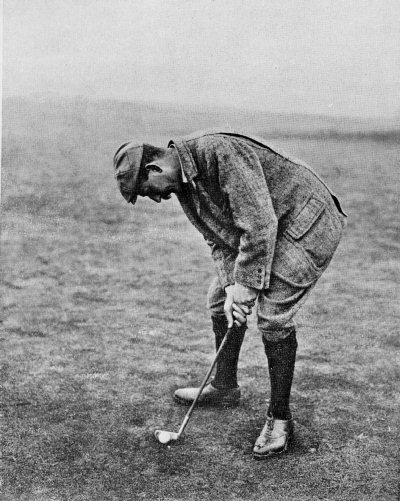
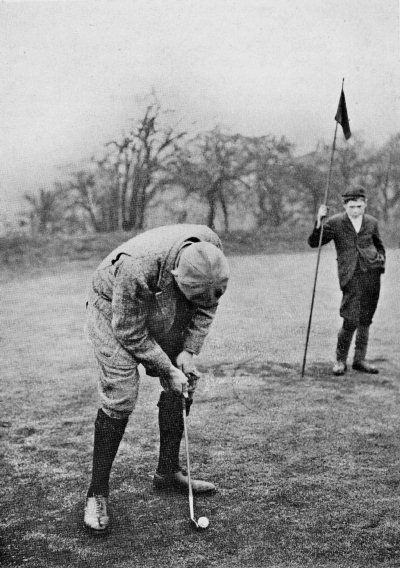
As you can see, he used a very short putter. And here's another view:
Vardon's refusal to give any measurements or diagrams regarding his stance is significant. Throughout his book, he is almost neurotic in his attention to detail when it comes to describing what he does and how he executes the various shots he plays. To simply say that 'putting is an individual matter and you'll just have to find what feels natural to you' is an amazing concession on his part!
His advice on how to find this natural stroke is also amazing, since it shows considerable insight. Think about this, folks: We often talk about how children putt better than most adults, and they get worse as they get older and develop 'scar tissue' from missed putts. Vardon's logic here is simple: Children putt better because their minds aren't full of other people's advice! They just putt the way that seems most logical to them. And Vardon says that's how you have to find your natural stroke:
Instead of thinking about how to putt, you should be thinking only about getting the ball in the hole, period. And notice that, later in the piece, he specifically says that you can't consciously try to standardize your stroke based on the days you putt well: it's all about comfort. And that makes sense, because you're human and your body feels a bit different each day, so if you could get in the exact same position each day, some days you'd putt well and some days you wouldn't because you still wouldn't feel right all the time.
Sounds like mysticism, doesn't it? That's why Vardon's method is not taught these days, but quantifiable technique is. Note that Vardon DOES say that, when your putting goes bad, it's probably because of a change in your stance. That's because your stance is your only connection to the ground and such a change would affect your balance, how you reach for the ball, the tension in your muscles, and so on.
And if you read on in that second paragraph, Vardon goes to far as to suggest that players get distracted by every little thing around them when they putt simply because they aren't comfortable over the ball that day.
Yes, this is only two paragraphs from the book, which is in the public domain here in the US. I'll try to pull out the best ideas at the end of this post, but there's considerable value in wading through Vardon's somewhat longwinded prose. Here is his advice on how to set up for a typical putt and how to think about the stroke itself.
For the proper playing of the other strokes in golf, I have told my readers to the best of my ability how they should stand and where they should put their feet. But except for the playing of particular strokes, which come within the category of those called "fancy," I have no similar instruction to offer in the matter of putting. There is no rule, and there is no best way. Sometimes you see a player bend down and hold the putter right out in front of him with both wrists behind the shaft. This is an eccentricity, but if the player in question believes that he can putt better in this way than in any other, he is quite justified in adopting it, and I would be the last to tell him that he is wrong. The fact is that there is more individuality in putting than in any other department of golf, and it is absolutely imperative that this individuality should be allowed to have its way. I believe seriously that every man has had a particular kind of putting method awarded to him by Nature, and when he putts exactly in this way he will do well, and when he departs from his natural system he will miss the long ones and the short ones too. First of all, he has to find out this particular method which Nature has assigned for his use. There ought not to be much difficulty about this, for it will come unconsciously to his aid when he is not thinking of anybody's advice or of anything that he has ever read in any book on golf. That day the hole will seem as big as the mouth of a coal mine, and putting the easiest thing in the world. When he stands to his ball and makes his little swing, he feels as easy and comfortable and confident as any man can ever do. Yet it is probable that, so far as he knows, he is not doing anything special. It may happen that the very next day, when he thinks he is standing and holding his club and hitting the ball in exactly the same way, he nevertheless feels distinctly uncomfortable and full of nervous hesitation as he makes his stroke, and then the long putts are all either too short, or too long, or wide, and the little ones are missed.Then Vardon includes these two photos. Unusual stance, huh?
I don't think that the liver or a passing variation in temperament is altogether the cause of this. I believe it is because the man has departed even by a trifle from his own natural stance. A change of the position of the feet by even a couple of inches one way or the other may alter the stance altogether, and knock the player clean off his putting. In this new position he will wriggle about and feel uncomfortable. Everything is wrong. His coat is in the way, his pockets seem too full of old balls, the feel of his stockings on his legs irritates him, and he is conscious that there is a nail coming up on the inside of the sole of his boot. It is all because he is just that inch or two removed from the stance which Nature allotted to him for putting purposes, but he does not know that, and consequently everything in the world except the true cause is blamed for the extraordinary things he does. A fair sample of many others was the clergyman who, having missed a short putt when playing in a match over a Glasgow links, espied in the distance on an eminence fully a quarter of a mile away from the green, an innocent tourist, who was apparently doing nothing more injurious to golf than serenely admiring the view. But the clerical golfer, being a man of quick temper, poured forth a torrent of abuse, exclaiming, "How could I hole the ball with that blockhead over there working his umbrella as if it were the pendulum of an eight-day clock!" When this is the kind of thing that is happening, I advise the golfer to try variations in his stance for putting, effecting the least possible amount of change at a time. There is a chance that at last he will drop into his natural stance, or something very near it, and even if he does not there is some likelihood that he will gain a trifle in confidence by the change, and that will count for much. And anyhow there is ample justification for any amount of man��uvring of the body and the feet when one is off one's putting, for at the best, to make use of something like an Irishism, the state of things is then hopelessly bad, and every future tendency must be in the way of improvement. There is one other suggestion to make to those golfers who believe what I say about the natural stance, and by this time it will have become more or less obvious to them. It is that when they are fairly on their putting, and are apparently doing all that Nature intended them to do, and are feeling contented in body and mind accordingly, they should take a sly but very careful look at their feet and body and everything else just after they have made a successful long putt, having felt certain all the time that they would make it. This examination ought not to be premeditated, because that would probably spoil the whole thing; and it usually happens that when one of these long ones has been successfully negotiated, the golfer is too much carried away by his emotions of delight to bring himself immediately to a sober and acute analysis of how it was done. But sometime he may remember to look into the matter, and then he should note the position of everything down to the smallest detail and the fraction of an inch, and make a most careful note of them for future reference. It will be invaluable. So, as I hold that putting is a matter of Nature and instinct, I make an exception this time to my rule in the matter of illustrations, and offer to my readers no diagram with stance measurements. From the two photographs of myself putting in what I had every reason to believe at the time was my own perfectly natural stance, they may take any hints that they may discover.
As you can see, he used a very short putter. And here's another view:
Vardon's refusal to give any measurements or diagrams regarding his stance is significant. Throughout his book, he is almost neurotic in his attention to detail when it comes to describing what he does and how he executes the various shots he plays. To simply say that 'putting is an individual matter and you'll just have to find what feels natural to you' is an amazing concession on his part!
His advice on how to find this natural stroke is also amazing, since it shows considerable insight. Think about this, folks: We often talk about how children putt better than most adults, and they get worse as they get older and develop 'scar tissue' from missed putts. Vardon's logic here is simple: Children putt better because their minds aren't full of other people's advice! They just putt the way that seems most logical to them. And Vardon says that's how you have to find your natural stroke:
...he has to find out this particular method which Nature has assigned for his use. There ought not to be much difficulty about this, for it will come unconsciously to his aid when he is not thinking of anybody's advice or of anything that he has ever read in any book on golf. That day the hole will seem as big as the mouth of a coal mine, and putting the easiest thing in the world.Unconscious putting -- a simple concept that goes against most modern instruction. Too much practice inhibits unconscious technique. And make no mistake about it, your 'natural stroke' is a technique; it's just not based on "I need to hold the club like this and stroke on this path and keep my wrists in this position at impact."
Instead of thinking about how to putt, you should be thinking only about getting the ball in the hole, period. And notice that, later in the piece, he specifically says that you can't consciously try to standardize your stroke based on the days you putt well: it's all about comfort. And that makes sense, because you're human and your body feels a bit different each day, so if you could get in the exact same position each day, some days you'd putt well and some days you wouldn't because you still wouldn't feel right all the time.
Sounds like mysticism, doesn't it? That's why Vardon's method is not taught these days, but quantifiable technique is. Note that Vardon DOES say that, when your putting goes bad, it's probably because of a change in your stance. That's because your stance is your only connection to the ground and such a change would affect your balance, how you reach for the ball, the tension in your muscles, and so on.
And if you read on in that second paragraph, Vardon goes to far as to suggest that players get distracted by every little thing around them when they putt simply because they aren't comfortable over the ball that day.
Which means that Vardon's guiding principle for putting is that you should feel comfortable when you stand over the ball, no matter what your technique looks like when you do. Because he says that is probably your natural way of putting, and therefore it's the method that will likely give you the most success.I'll stop there. There is so much about the mindset of putting that can be gleaned from these two lengthy paragraphs! Even sports psychologists could find some useful material here. So I'll leave it to you, to search for clues that might help you improve your own putting.
Saturday, May 26, 2018
Ged Walters on Hitting a Draw (Video)
Golf Monthly's Ged Walters did this cool video on hitting a draw. Why is it so cool? Because he's hitting irons off the fairway, not drivers off the tee! And to make it even better, he's hitting from a hanging lie, which makes the shot even tougher.
The fundamental things he teaches here are not new or unique, but his presentation is one of the simplest I've seen. Let me point out a couple of things he says.
First of all, I like how he distinguishes between a draw and a hook. It's not about how big the curve is, but about whether the ball is getting closer to the target or farther away at the end. A draw curves out and and finishes "on target" -- that means it's still moving toward the target when it stops. A hook curves around too much, so that it moves past the target and keeps moving away from it. A hook is out of control. That's a good way to think about it.
He likens the way you strike the ball with the club to the way a footballer kicks the ball. (For my American readers, we'd call it soccer.) The kicker strikes the ball with the inside of his foot; the inside of his foot is facing the target while his foot is moving out to the right (you lefties would be moving to the left).
And playing off a hanging lie? You just exaggerate this action. A very simple explanation.
If there's one key technical thought I'd like you to remember, it's that you position the ball just slightly back of center in your stance. You want to come at the ball slightly from the inside with your swing -- that's the footballer analogy again -- and moving the ball back slightly encourages that, without having to make a huge change to your swing. You might even want to stand slightly farther from the ball, simply because that will help you hit from the inside more easily, without a lot of conscious thought.
Walters has -- in my opinion -- done a real service to weekend players with this explanation of how to play a draw off the turf with an iron. So spend a little time with this video. It'll be well worth your time.
The fundamental things he teaches here are not new or unique, but his presentation is one of the simplest I've seen. Let me point out a couple of things he says.
First of all, I like how he distinguishes between a draw and a hook. It's not about how big the curve is, but about whether the ball is getting closer to the target or farther away at the end. A draw curves out and and finishes "on target" -- that means it's still moving toward the target when it stops. A hook curves around too much, so that it moves past the target and keeps moving away from it. A hook is out of control. That's a good way to think about it.
He likens the way you strike the ball with the club to the way a footballer kicks the ball. (For my American readers, we'd call it soccer.) The kicker strikes the ball with the inside of his foot; the inside of his foot is facing the target while his foot is moving out to the right (you lefties would be moving to the left).
And playing off a hanging lie? You just exaggerate this action. A very simple explanation.
If there's one key technical thought I'd like you to remember, it's that you position the ball just slightly back of center in your stance. You want to come at the ball slightly from the inside with your swing -- that's the footballer analogy again -- and moving the ball back slightly encourages that, without having to make a huge change to your swing. You might even want to stand slightly farther from the ball, simply because that will help you hit from the inside more easily, without a lot of conscious thought.
Walters has -- in my opinion -- done a real service to weekend players with this explanation of how to play a draw off the turf with an iron. So spend a little time with this video. It'll be well worth your time.
Wednesday, May 23, 2018
Kristin Sunderhaft on Ball Position (Video)
Kristin Sunderhaft, an LPGA teaching pro in Las Vegas, did this video some time back on ball position. It's helpful because you can actually see how she's positioning the ball, so have a look:
Kristin teaches three ball positions for your full swing, depending on what club you're using. That may sound different from what I teach -- I position the ball under my hands -- but bear in mind that, as the clubs get longer, my arms have to reach out a bit and that straightens my trailing elbow. And as that happens, my hands move a bit more toward the target as the clubs get longer.
So Kristen's method isn't really that much different from mine, but many of you may find it easier to understand what's happening when you see her in the video. So here are the three ball positions:
One last thought: You may think this setup with the two clubs is a reasonably recent invention, perhaps since Hogan really started focusing on mechanics. But here's a photo I posted in a past post about Harry Vardon's method for playing a draw. See anything familiar?
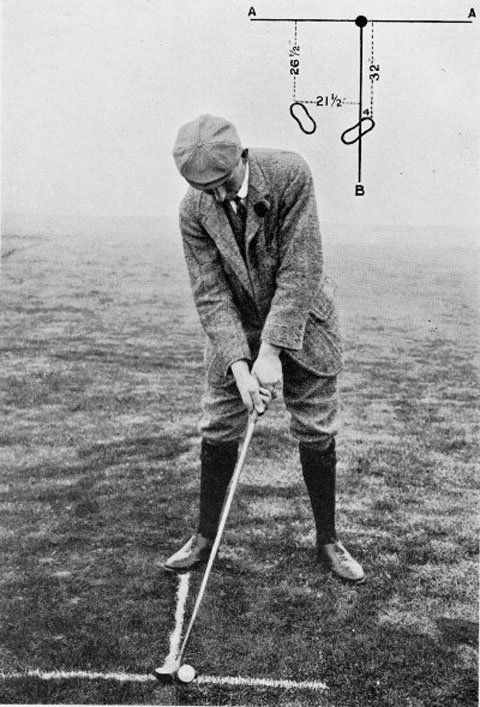
That line drawing in the upper right-hand corner -- and the chalk lines drawn on the ground -- are doing the exact same thing as Kristin's clubs. This is a time-honored method of visualizing ball position, and you should make use of it too.
Kristin teaches three ball positions for your full swing, depending on what club you're using. That may sound different from what I teach -- I position the ball under my hands -- but bear in mind that, as the clubs get longer, my arms have to reach out a bit and that straightens my trailing elbow. And as that happens, my hands move a bit more toward the target as the clubs get longer.
So Kristen's method isn't really that much different from mine, but many of you may find it easier to understand what's happening when you see her in the video. So here are the three ball positions:
- Wedges: Ball in the center of your stance.
- Driver: Ball just off your lead heel or lead instep.
- All other clubs: Ball is slightly left of the center position.
One last thought: You may think this setup with the two clubs is a reasonably recent invention, perhaps since Hogan really started focusing on mechanics. But here's a photo I posted in a past post about Harry Vardon's method for playing a draw. See anything familiar?
That line drawing in the upper right-hand corner -- and the chalk lines drawn on the ground -- are doing the exact same thing as Kristin's clubs. This is a time-honored method of visualizing ball position, and you should make use of it too.
Sunday, May 20, 2018
Kathy Hart Wood on Chipping with a Hybrid (Video)
This video from LPGA teaching pro Kathy Hart Wood focuses on chipping with a hybrid but -- at least to me -- this video seems to take a different tack than others on the topic. Here, take a look:
There are two important things for you to note here.
You stand closer to the ball as a result, so you might have to bend your elbows outward a bit, and you want the ball just ahead of the center of your stance. She says your eyes will be over the ball; that means your weight is slightly on your lead foot. Nothing complicated here, just standard short game technique but using your putting stroke.
As for chipping from the fairway with your hybrid -- and again, note that she is using a 4- or 5-hybrid -- this is a strategy play, something you use as a conscious decision and not just because "I always chip with my hybrid." She is using this technique when she's got some ground to cover with the chip.
Very basic info here but, as we have seen with Jordan Spieth's putting struggles lately, basic stuff is usually what goes wrong when our games get out of whack. You won't find a much simpler explanation of hybrid chipping than in this Wood video.
There are two important things for you to note here.
- First, playing a hybrid well is mostly a matter of setup. She devotes most of this video to proper setup, so you want to pay attention to that.
- Second -- and I want to stress this, since this stood out to me in her presentation -- this is NOT a shot that you want to use out of the rough. Many times "hybrid chipping" is offered as a generic alternative for dealing with chipping problems, but it's not. Kathy stresses using this method from the short grass and, as you can see, she can use it from quite a distance from the hole!
You stand closer to the ball as a result, so you might have to bend your elbows outward a bit, and you want the ball just ahead of the center of your stance. She says your eyes will be over the ball; that means your weight is slightly on your lead foot. Nothing complicated here, just standard short game technique but using your putting stroke.
As for chipping from the fairway with your hybrid -- and again, note that she is using a 4- or 5-hybrid -- this is a strategy play, something you use as a conscious decision and not just because "I always chip with my hybrid." She is using this technique when she's got some ground to cover with the chip.
Very basic info here but, as we have seen with Jordan Spieth's putting struggles lately, basic stuff is usually what goes wrong when our games get out of whack. You won't find a much simpler explanation of hybrid chipping than in this Wood video.
Saturday, May 5, 2018
Ball Positioning: Feet VS Hands
This is a response to a comment Dana left on my post about Claude Harmon III's setup advice. In that post I mentioned there was a difference between using your feet and your hands to position your golf ball. Dana asked for a bit more detail, so here we go.
Let's start with a theoretical setup with the ball positioned right in the middle of your stance. Your weight is evenly divided between your feet, and a vertical line (dotted in the diagrams that follow) would pass through your chin, along your spine, through your hands and split the ball exactly in half in the middle of your stance.
As you can see, in this admittedly perfect setup, the clubhead sits just behind the ball at address and, as the curved line with the arrow shows, its swing path would contact the ball perfectly and take a tiny divot just after you hit the ball.
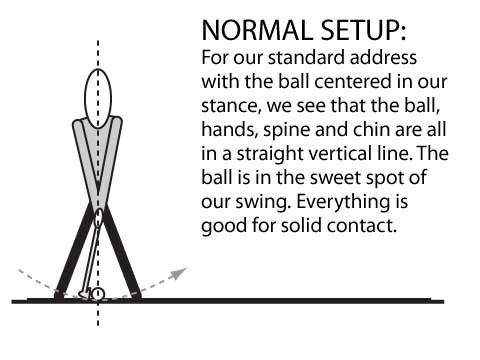
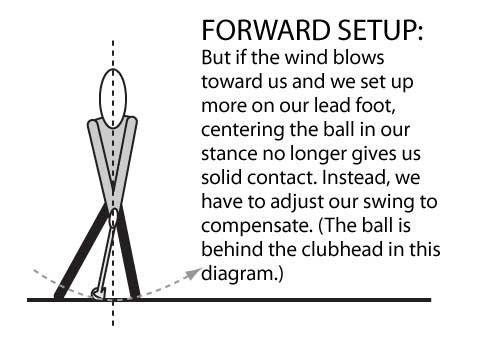
But this is a perfect address position, after all. Let's suppose -- simply because we need a situation that you might commonly experience -- that there's a stiff wind blowing at us from the direction of the target. In order to steady ourselves, we shift our weight a bit forward, placing more weight on our lead foot. As you can see in the diagram below, the vertical dotted line shows that our spine has shifted forward.
However, since the ball is positioned in the center of our stance -- that is, we positioned the ball using our feet -- the ball is no longer in the correct position for solid contact. In fact, the ball is actually hidden by the clubhead in this diagram! If you position the ball relative to your feet, you'll have to make changes to your swing just so you can get the ball in the air.
But what if we had been using our hands to position the ball? In the original diagram, the ball was also directly under our hands. What if we had set our weight forward to resist the wind BUT we still positioned the ball under our hands?
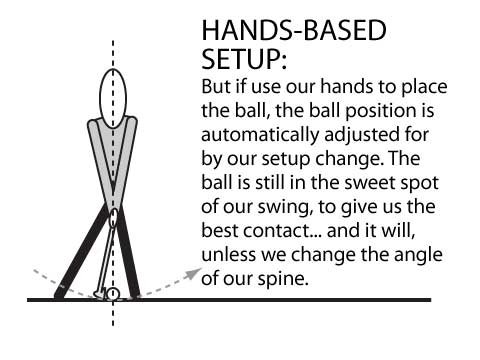
As you can see from the final diagram, the ball is still in the correct position relative to our head and our spine, which is the critical thing here if we want to keep our swing arc consistent. In this final address position, we'll make the same solid contact with the ball that we would have made in the original setup in the first diagram.
And as long as we don't lean our spine toward (or away from) the target, positioning the ball relative to our hands means we automatically keep our swing consistent.
Obviously we're talking about stances on fairly level ground here. If we have a serious uphill or downhill lie, we'll always have to adjust our swing. But for the vast majority of normal stances, just letting your hands hang down and setting up so the ball is directly beneath them gives you the most consistent method of creating solid contact.
Now I have to admit, it's not exactly correct to say the ball is UNDER your hands. The ball would be much too close to your body if that was the case. It would be more correct to say that, if you drew a line on the ground extending away from you -- imagine a line connecting your feet, and the "ball line" would form a T with that line -- the ball would be on that line far enough away that your could make proper contact with the clubface. When using this method, you just let your hands and arms hang down, then position the ball so that the T is directly under your hands.
Hopefully that's pretty clear. (I didn't think to make a diagram showing the T positioning method, so that may be a bit hazy.) If you have any questions, you can just put them in the comments below and I'll try to do a better job. But once you've done it a time or two, I think you'll agree it really simplifies your setup with all but the most difficult stances.
Let's start with a theoretical setup with the ball positioned right in the middle of your stance. Your weight is evenly divided between your feet, and a vertical line (dotted in the diagrams that follow) would pass through your chin, along your spine, through your hands and split the ball exactly in half in the middle of your stance.
As you can see, in this admittedly perfect setup, the clubhead sits just behind the ball at address and, as the curved line with the arrow shows, its swing path would contact the ball perfectly and take a tiny divot just after you hit the ball.
But this is a perfect address position, after all. Let's suppose -- simply because we need a situation that you might commonly experience -- that there's a stiff wind blowing at us from the direction of the target. In order to steady ourselves, we shift our weight a bit forward, placing more weight on our lead foot. As you can see in the diagram below, the vertical dotted line shows that our spine has shifted forward.
However, since the ball is positioned in the center of our stance -- that is, we positioned the ball using our feet -- the ball is no longer in the correct position for solid contact. In fact, the ball is actually hidden by the clubhead in this diagram! If you position the ball relative to your feet, you'll have to make changes to your swing just so you can get the ball in the air.
But what if we had been using our hands to position the ball? In the original diagram, the ball was also directly under our hands. What if we had set our weight forward to resist the wind BUT we still positioned the ball under our hands?
As you can see from the final diagram, the ball is still in the correct position relative to our head and our spine, which is the critical thing here if we want to keep our swing arc consistent. In this final address position, we'll make the same solid contact with the ball that we would have made in the original setup in the first diagram.
And as long as we don't lean our spine toward (or away from) the target, positioning the ball relative to our hands means we automatically keep our swing consistent.
Obviously we're talking about stances on fairly level ground here. If we have a serious uphill or downhill lie, we'll always have to adjust our swing. But for the vast majority of normal stances, just letting your hands hang down and setting up so the ball is directly beneath them gives you the most consistent method of creating solid contact.
Now I have to admit, it's not exactly correct to say the ball is UNDER your hands. The ball would be much too close to your body if that was the case. It would be more correct to say that, if you drew a line on the ground extending away from you -- imagine a line connecting your feet, and the "ball line" would form a T with that line -- the ball would be on that line far enough away that your could make proper contact with the clubface. When using this method, you just let your hands and arms hang down, then position the ball so that the T is directly under your hands.
Hopefully that's pretty clear. (I didn't think to make a diagram showing the T positioning method, so that may be a bit hazy.) If you have any questions, you can just put them in the comments below and I'll try to do a better job. But once you've done it a time or two, I think you'll agree it really simplifies your setup with all but the most difficult stances.
Sunday, April 29, 2018
Claude Harmon III on a Simpler Short Game Setup
First, make sure you understand that the first photo below shows THE WRONG WAY to set up for general short game shots. At least, that's what Claude Harmon III says in this Golf Digest instruction article. It's called Want a More Consistent Short Game? Simplify Your Setup.
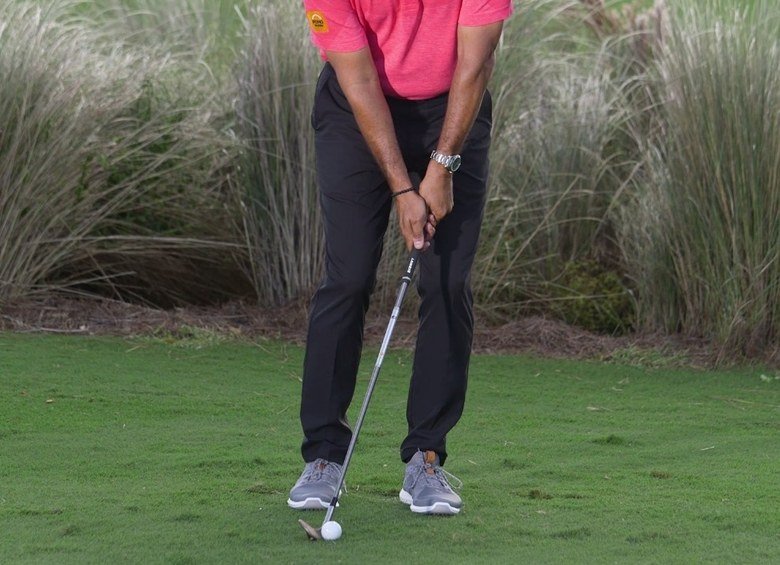
Harmon says this address position, which is a popular recommendation as of late, isn't good for most of the short shots an average golfer faces. It's great for hitting a low running shot but it does so by delofting the clubface. That makes it harder to get the ball up in the air for other shots without skulling or scooping the ball.
Here's Harmon's recommendation:
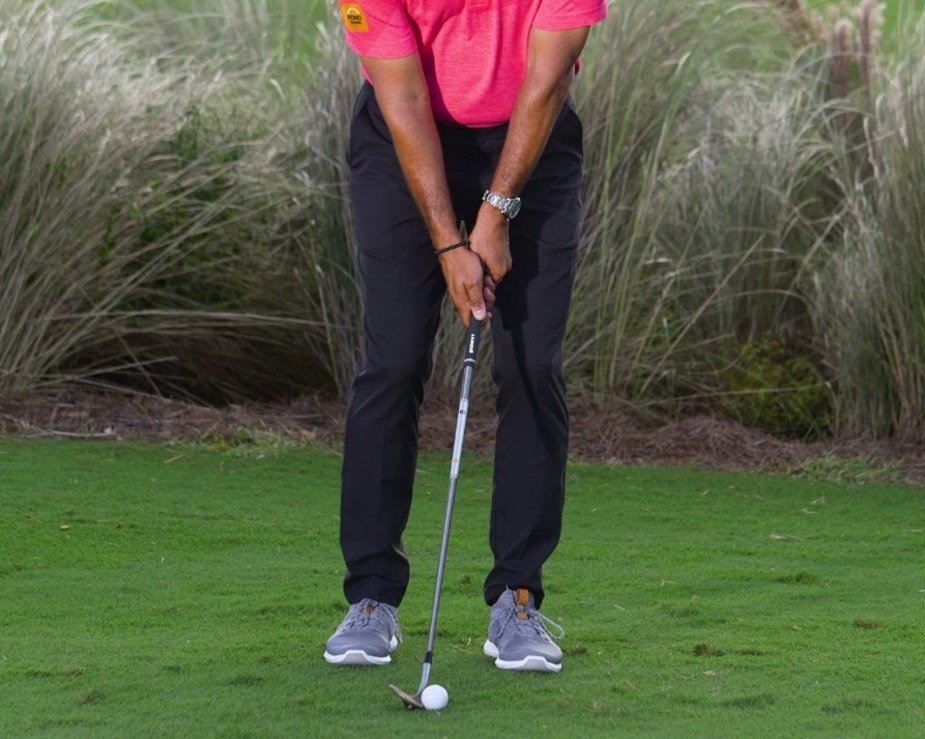
By centering the ball in your stance, you minimize the chance of a mis-hit. And if you need to hit a low shot, you can just use a club with less loft.
The difference between Harmon's setup and the one I generally recommend is small. I like to have the ball under my hands -- which puts the ball slightly ahead of center -- while Harmon has his hands slightly ahead of the ball. He uses his feet to position the ball while I use my hands to position the ball. That's why we have a difference; I feel it's easier to create the same position each time using my method. (I also tend to use a less-lofted club for standard shots; I like to hit lower shots when I can.) But we're both using the same concept -- the closer the ball is to the low spot in your short game stroke, the more consistent your contact will be.
Harmon's article is short and you'll want to take a look at it, if for no other reason than to learn what Tiger told him about short game setup. But in any case, the guiding principle is this: With short game as with most other things in life, it's better to avoid extremes when you can.
Harmon says this address position, which is a popular recommendation as of late, isn't good for most of the short shots an average golfer faces. It's great for hitting a low running shot but it does so by delofting the clubface. That makes it harder to get the ball up in the air for other shots without skulling or scooping the ball.
Here's Harmon's recommendation:
By centering the ball in your stance, you minimize the chance of a mis-hit. And if you need to hit a low shot, you can just use a club with less loft.
The difference between Harmon's setup and the one I generally recommend is small. I like to have the ball under my hands -- which puts the ball slightly ahead of center -- while Harmon has his hands slightly ahead of the ball. He uses his feet to position the ball while I use my hands to position the ball. That's why we have a difference; I feel it's easier to create the same position each time using my method. (I also tend to use a less-lofted club for standard shots; I like to hit lower shots when I can.) But we're both using the same concept -- the closer the ball is to the low spot in your short game stroke, the more consistent your contact will be.
Harmon's article is short and you'll want to take a look at it, if for no other reason than to learn what Tiger told him about short game setup. But in any case, the guiding principle is this: With short game as with most other things in life, it's better to avoid extremes when you can.
Tuesday, April 17, 2018
Kaylin Skovron and Michael Breed's Driving Tips
Golf Digest posted a couple of articles with simple driving tips that you might find useful.
The first is from an article by instructor Kaylin Skovron called 5-Minute Clinic: How to Make Swing Adjustments for Different Shots. It has a number of different tips but the driving tip is simple.

She recommends a change to your driving setup to get more distance. As she puts it:
Once you get set up for more distance, you need to get a bigger swing. Michael Breed has a short article called One Driver Swing Thought for Longer and Straighter Drives... and it's a simple one. Just keep your trail arm straight for as long as possible in your backswing.
I'd better explain this one a bit.
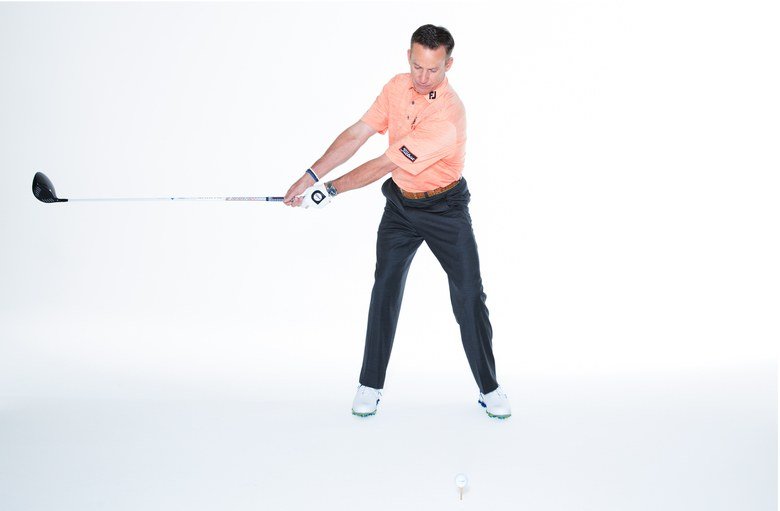
This photo looks like a pretty stiff-armed takeaway, doesn't it? It's misleading. It just LOOKS that way because Michael hasn't bent his trailing elbow. If you try it with a club, you'll find that you can stay pretty relaxed for quite a long time as you make your backswing, even though your elbow isn't bending.
"Keeping your trailing elbow straight for a long time" is one way to keep the club farther away from your head at the top of your backswing. Players like Annika say this is a primary swing thought with them.
Bear in mind that your elbow WILL bend at the top of your backswing. Michael probably can't get much farther than the photo shows without bending his elbow. But at the top, instead of a 90° angle, it'll be more like 75° or so. IT'S STILL BENT, just not as much. It bends a bit more as you start down, which helps you keep your wrist cock later into your downswing, and that gives you more distance.
Don't overdo the bend on the way down. It always feels as if your trail arm is straighter than it actually is, so if you try to feel a right angle bend you'll probably smack your shoulders with the club shaft! If you stay relaxed and just feel as if your trail arm is staying at about the same angle, you'll probably get the result you want.
And between these two tips, you may be able to pick up some extra distance without too much effort.
The first is from an article by instructor Kaylin Skovron called 5-Minute Clinic: How to Make Swing Adjustments for Different Shots. It has a number of different tips but the driving tip is simple.
She recommends a change to your driving setup to get more distance. As she puts it:
To get the best launch and spin with a driver, play the ball forward in your stance and hit up on it. But if you have it aligned with your front heel (above, left), and you're still hitting it too low (and often crooked), play it even farther forward so the ball is lined up off the toes of the front foot (above, right). Address it with your feet together, and then step away from the target with your trail foot. Now you're set up to launch it higher—and hopefully straighter.It won't work for everybody; it depends on your swing mechanics. Still, it's worth trying out.
Once you get set up for more distance, you need to get a bigger swing. Michael Breed has a short article called One Driver Swing Thought for Longer and Straighter Drives... and it's a simple one. Just keep your trail arm straight for as long as possible in your backswing.
I'd better explain this one a bit.
This photo looks like a pretty stiff-armed takeaway, doesn't it? It's misleading. It just LOOKS that way because Michael hasn't bent his trailing elbow. If you try it with a club, you'll find that you can stay pretty relaxed for quite a long time as you make your backswing, even though your elbow isn't bending.
"Keeping your trailing elbow straight for a long time" is one way to keep the club farther away from your head at the top of your backswing. Players like Annika say this is a primary swing thought with them.
Bear in mind that your elbow WILL bend at the top of your backswing. Michael probably can't get much farther than the photo shows without bending his elbow. But at the top, instead of a 90° angle, it'll be more like 75° or so. IT'S STILL BENT, just not as much. It bends a bit more as you start down, which helps you keep your wrist cock later into your downswing, and that gives you more distance.
Don't overdo the bend on the way down. It always feels as if your trail arm is straighter than it actually is, so if you try to feel a right angle bend you'll probably smack your shoulders with the club shaft! If you stay relaxed and just feel as if your trail arm is staying at about the same angle, you'll probably get the result you want.
And between these two tips, you may be able to pick up some extra distance without too much effort.
Friday, April 6, 2018
Martin Hall on Long Drive Setup (Video)
The Masters is on and you don't have time for instructional videos -- or practice. You're in luck! Martin Hall and Blair O'Neal posted this Night School video just yesterday, and you don't need a club or a trip to the range to improve your driving.
The drill is simple. Park your buttt against a wall and, before you start your "backswing," bump your hips a little toward your target. Note that:
Why does this work? Because if you set your weight just a bit forward at setup, you'll tend to return to that position at impact. But you don't want to hit down with a driver, and that's why you leave your weight distributed roughly 50-50 between your feet and just bump your hips forward a bit. You'll automatically tilt your spine just slightly away from the target to keep your balance, but it will be enough to create all the good things you want at impact.
So remember: Just a slight hip bump toward the target at setup, which causes a very slight spine tilt away from the target. That will automatically create the weight shift you want on the downswing, along with the upward strike at your teed-up golf ball. Voila! Longer drives.
And you still get to watch the Masters. Just do the drill during commercials!
The drill is simple. Park your buttt against a wall and, before you start your "backswing," bump your hips a little toward your target. Note that:
- you do this at setup before you make your backswing, not during your downswing, and
- the move is small. Martin says just two inches. You want just enough to get you swinging upward at impact.
Why does this work? Because if you set your weight just a bit forward at setup, you'll tend to return to that position at impact. But you don't want to hit down with a driver, and that's why you leave your weight distributed roughly 50-50 between your feet and just bump your hips forward a bit. You'll automatically tilt your spine just slightly away from the target to keep your balance, but it will be enough to create all the good things you want at impact.
So remember: Just a slight hip bump toward the target at setup, which causes a very slight spine tilt away from the target. That will automatically create the weight shift you want on the downswing, along with the upward strike at your teed-up golf ball. Voila! Longer drives.
And you still get to watch the Masters. Just do the drill during commercials!
Friday, March 30, 2018
Xander Schauffele on Hitting It Long
Xander Schauffele did an article for Golf Digest on some of his tips for getting big distance when you're a smaller person. You can follow the link to learn some of his tips and feels, but I want to point out one specific thing he says which is different from what you may have heard most instructors say.

Xander uses a neutral grip, which goes against the advice most instructors give -- that is, that a strong grip makes for a more powerful strike. But Xander's definition of a neutral grip is very interesting. Here's what he says:
He says these things will help you to get better hand action so you hit the ball farther. He certainly ought to know!
There are several interesting ideas in Xander's article, but this one about the grip really stood out to me. It's pretty clear that Xander is trying to move freely, not "hold" anything in an attempt to create some special position. That mindset change in and of itself might help you get more distance than you do now.
Xander uses a neutral grip, which goes against the advice most instructors give -- that is, that a strong grip makes for a more powerful strike. But Xander's definition of a neutral grip is very interesting. Here's what he says:
One thing that will help you unleash that power at the right moment is your grip. Mine is neutral. For a stock shot, I see only one knuckle on my glove hand when I look down. This grip allows me to hit draws or fades when I want to. It also lets me release the clubhead into the ball like I���m hammering that nail. If your grip is too strong, you can���t fully release the clubhead, typically resulting in a loss of speed. And a grip that���s too weak makes it tough to square the clubface at impact, so you lose control.You get that? He can only see ONE knuckle, not two or three. Take a good look at that photo above from the article. Xander also notes that he wants to club shaft almost vertical at address for a drive, not leaning forward. That's important because it works with the one-knuckle grip to get the hands in the proper position at impact. Make sure you read what he says about the one-knuckle grip, shaft lean and ball position at address so you don't turn your grip too weak.
He says these things will help you to get better hand action so you hit the ball farther. He certainly ought to know!
There are several interesting ideas in Xander's article, but this one about the grip really stood out to me. It's pretty clear that Xander is trying to move freely, not "hold" anything in an attempt to create some special position. That mindset change in and of itself might help you get more distance than you do now.
Saturday, March 24, 2018
Brian Harman on Ball Position (Video)
I have a surprise for you lefties today. I found a site with several Brian Harman video tips! And since Brian shocked a lot of analysts by beating the big guns to reach the Sweet16 at the Dell Match Play, I thought I'd post one of them. This one's on ball position.
In this video Brian teaches how he gets the ball in the same position each time and how he adjusts the position for fades and draws. It's really simple -- most good golf instruction is -- but it's not often you see this material filmed for lefties.
Of course, you righties can use it too. But you'll have to do what the lefties normally have to do -- mentally reverse it before you try it! That may actually help you understand and remember the instruction better. Give it a try!
BTW, each of those photo links on the SecretGolf.com page links to several other videos in each category, so there will be plenty for you to check out. Hope you enjoy it!
In this video Brian teaches how he gets the ball in the same position each time and how he adjusts the position for fades and draws. It's really simple -- most good golf instruction is -- but it's not often you see this material filmed for lefties.
Of course, you righties can use it too. But you'll have to do what the lefties normally have to do -- mentally reverse it before you try it! That may actually help you understand and remember the instruction better. Give it a try!
BTW, each of those photo links on the SecretGolf.com page links to several other videos in each category, so there will be plenty for you to check out. Hope you enjoy it!
Sunday, March 4, 2018
Brandel Chamblee on "the Magic Move" (Video)
I know many of you don't care for Brandel Chamblee, and you know I don't agree with him on everything either. But this short video he did on what he calls "the Magic Move" is a good explanation of what many successful pros have done to get distance.
I want to focus on that "straight right leg" he mentions. (And add that Arnold Palmer may have been the best example of it.) Bear in mind that you aren't necessarily "locking" that knee; it may have a slight flex in it. But it's a very slight flex -- slight enough that it almost feels locked, but without the stress you feel in a locked knee joint. It's straight enough that it doesn't bend easily.
If you let your trailing knee straighten during your backswing, it may sound as if it will limit your ability to launch into your downswing. What it actually does is stop you from "spinning out" at the top as you start down:
And as Brandel points out, it's really hard to argue with the success of the players who have used it. It's one of those techniques that I put in the "it's worth a try" category, because if it won't work with your swing, you'll know pretty quick and won't have to waste a lot of time trying it.
But if it works for you... well, Arnie had a pretty good record.
I want to focus on that "straight right leg" he mentions. (And add that Arnold Palmer may have been the best example of it.) Bear in mind that you aren't necessarily "locking" that knee; it may have a slight flex in it. But it's a very slight flex -- slight enough that it almost feels locked, but without the stress you feel in a locked knee joint. It's straight enough that it doesn't bend easily.
If you let your trailing knee straighten during your backswing, it may sound as if it will limit your ability to launch into your downswing. What it actually does is stop you from "spinning out" at the top as you start down:
- That straightness makes a fuller hip turn feel more natural, and it almost doesn't require any extra thought on your part. (Automatic moves -- when they're correct -- almost always improve your ballstriking.)
- It makes it easier to stay relatively still over the ball (no sway during your backswing) without putting extra stress on your back.
- Since you have to turn your hips to start the downswing rather than pushing hard with your thigh, it smooths out the start of your downswing.
- You don't have to "drive" forward to get a weight shift to your lead foot -- a straight trailing leg forces you to "fall onto" your lead foot. Instant weight shift!
- And once your upper body begins to turn with your hips during your downswing, your trailing knee will start to bend automatically. That puts you in position to start using the ground to push up at impact, but it keeps the "push up" under control so you don't overdo it and mis-hit the ball.
And as Brandel points out, it's really hard to argue with the success of the players who have used it. It's one of those techniques that I put in the "it's worth a try" category, because if it won't work with your swing, you'll know pretty quick and won't have to waste a lot of time trying it.
But if it works for you... well, Arnie had a pretty good record.
Saturday, February 3, 2018
When to Change Your Ball Position
A couple of days back I posted a video showing how Cristie Kerr positions her ball at setup with a driver. But the driver is different from other clubs since the ball is on a tee. What do you do with the other clubs?
I was digging through some old Golf Magazines and found an interesting one from March 2002. It had an article called Which Way? that claimed to sort out some of the conflicting advice you often come across.
One of the sections was on setup, about whether you should use one ball position for all your clubs or vary your ball position. Their perspective made a lot of sense to me so I'm passing it on.
According to this article, the best time to use a single ball position for all your clubs is when you're making a standard full swing shot. The single ball position always places the ball an inch or two inside your lead heel -- or, if you prefer, even with the logo on your golf shirt (if it has one). With this method, the width of your stance (how far back you move your trailing foot) determines how far forward the ball is in your stance.
On a standard full shot, a single ball position obviously gives you more consistency in your setup because the ball is always in roughly the same position relative to your lead shoulder. (That makes the impact angle of the clubface and ball similar on every shot.) It also helps you stay slightly behind the ball during your swing, which should help you get more distance and -- since your swing will be more consistent -- more accuracy.
By contrast, the best time to vary your ball position is when you want to play a different type of shot (rather than your standard shot) or when you have a bad lie. By moving the ball back farther in your stance, you can get a more downward strike on the ball when you have a bad lie or just need to keep your ball flight down. Or you can move the ball farther forward with your driver, which can be helpful when you want to hit the ball higher to take advantage of a downwind situation.
So there are some thoughts that might help you develop a more consistent approach to ball position. The fewer changes you have to make for each shot -- and therefore the less confusion you have over each shot -- the more likely you are to make the shot you intended.
I was digging through some old Golf Magazines and found an interesting one from March 2002. It had an article called Which Way? that claimed to sort out some of the conflicting advice you often come across.
One of the sections was on setup, about whether you should use one ball position for all your clubs or vary your ball position. Their perspective made a lot of sense to me so I'm passing it on.
According to this article, the best time to use a single ball position for all your clubs is when you're making a standard full swing shot. The single ball position always places the ball an inch or two inside your lead heel -- or, if you prefer, even with the logo on your golf shirt (if it has one). With this method, the width of your stance (how far back you move your trailing foot) determines how far forward the ball is in your stance.
On a standard full shot, a single ball position obviously gives you more consistency in your setup because the ball is always in roughly the same position relative to your lead shoulder. (That makes the impact angle of the clubface and ball similar on every shot.) It also helps you stay slightly behind the ball during your swing, which should help you get more distance and -- since your swing will be more consistent -- more accuracy.
By contrast, the best time to vary your ball position is when you want to play a different type of shot (rather than your standard shot) or when you have a bad lie. By moving the ball back farther in your stance, you can get a more downward strike on the ball when you have a bad lie or just need to keep your ball flight down. Or you can move the ball farther forward with your driver, which can be helpful when you want to hit the ball higher to take advantage of a downwind situation.
So there are some thoughts that might help you develop a more consistent approach to ball position. The fewer changes you have to make for each shot -- and therefore the less confusion you have over each shot -- the more likely you are to make the shot you intended.
Thursday, February 1, 2018
Cristie Kerr's Driver Setup (Video)
This short clip is from Cristie's driver special on Golf Channel Academy that aired Tuesday night. The way she sets up is so simple that I wanted to post it here.
Here's what she does:
It really doesn't get much simpler than that. And Cristie's success with her driver proves it works. It's a good way to develop a consistent stance and ball position with the driver, and it doesn't take a lot of fidgeting to get it right.
Here's what she does:
- To start, with both feet together, she positions herself so the ball would be right in center of her stance. Just draw a straight line from between her feet and the ball is THERE.
- Since she's righthanded, she turns her left (lead) foot slightly toward the target. Note that she doesn't step toward the target with her lead foot, she just pivots it on her heel.
- She steps back with her right (trailing) foot and stands so her weight is pretty even on each foot.
It really doesn't get much simpler than that. And Cristie's success with her driver proves it works. It's a good way to develop a consistent stance and ball position with the driver, and it doesn't take a lot of fidgeting to get it right.
Sunday, January 14, 2018
Todd Casabella on Stopping the Shanks (Video)
I know I post a lot of videos and tips about shanking, but that's because I know lots of you have this problem from time to time... and let's face it, one fix does not fit all. So here is instructor Todd Casabella's tip on how to stop shanking.
Now, let's get one thing straight. While shanks are often caused by standing too far from the ball, standing too close can cause them too. You need to identify which it is with you but, once you learn what to look for, it's not too hard to track down the cause. Todd's tip is for those standing too far away from the ball.
Todd says that standing too far from the ball causes you to lean forward and put your weight over your toes, basically falling toward the ball when you swing. To prevent this, he wants you to move the ball a bit closer, set up with your weight already over your toes, and "rock back" onto your heels as you make your downswing. It's not a dramatic move, but most problems in golf usually aren't. Anyway, if you're reaching for the ball at setup, this is a good thing to try.
This is only one of the things you can try if you have problems with the dreaded shank. But this is a simple fix and, if it works, it shouldn't take you long to integrate it into your swing -- this fix should be compatible with almost any instructor's swing method.
Now, let's get one thing straight. While shanks are often caused by standing too far from the ball, standing too close can cause them too. You need to identify which it is with you but, once you learn what to look for, it's not too hard to track down the cause. Todd's tip is for those standing too far away from the ball.
Todd says that standing too far from the ball causes you to lean forward and put your weight over your toes, basically falling toward the ball when you swing. To prevent this, he wants you to move the ball a bit closer, set up with your weight already over your toes, and "rock back" onto your heels as you make your downswing. It's not a dramatic move, but most problems in golf usually aren't. Anyway, if you're reaching for the ball at setup, this is a good thing to try.
This is only one of the things you can try if you have problems with the dreaded shank. But this is a simple fix and, if it works, it shouldn't take you long to integrate it into your swing -- this fix should be compatible with almost any instructor's swing method.
Friday, December 29, 2017
Ben Hogan on the Waggle
Ben Hogan needs no introduction. Besides his legendary return from a near-fatal car crash to become a nine-time major winner, his book Five Lessons is considered a foundational text for modern golf instructors. Today's quote is from that book.
I confess that, while I think Hogan was brilliant, he was a bit too mechanical for my tastes. But I also believe -- and I try to repeat it frequently in this blog -- that every golfer is different. If you find a swing method that works for you (and doesn't hurt!) then you should ignore the critics and stick with it. And I know a number of you have great success following Hogan's approach.
But many of you don't waggle the way he taught Let Ben tell you how it's done in his own words. Bear in mind that he was righthanded, so you lefties will need to take that into account. And yes, he wrote a lot of this section in ALL CAPS.
Although I feel Hogan's swing was too mechanical, he clearly didn't think so -- especially where the waggle was concerned. Later on p67 he says:
Regardless of how Hogan-esque your technique may or may not be, the waggle's purpose is to relieve the tension in your hands and arms while preparing them for the motion in your takeaway. No matter who you are or what technique you use, you can learn something from Ben Hogan.
I confess that, while I think Hogan was brilliant, he was a bit too mechanical for my tastes. But I also believe -- and I try to repeat it frequently in this blog -- that every golfer is different. If you find a swing method that works for you (and doesn't hurt!) then you should ignore the critics and stick with it. And I know a number of you have great success following Hogan's approach.
But many of you don't waggle the way he taught Let Ben tell you how it's done in his own words. Bear in mind that he was righthanded, so you lefties will need to take that into account. And yes, he wrote a lot of this section in ALL CAPS.
In the waggle, the left hand is the controlling hand. The right works along with the left. EACH TIME YOU WAGGLE THE CLUB BACK, THE RIGHT ELBOW SHOULD HIT THE FRONT PART OF YOUR RIGHT HIP, JUST ABOUT WHERE YOUR WATCH POCKET IS. WHEN THIS TAKES PLACE, THE LEFT ELBOW, AS IT MUST, COMES OUT SLIGHTLY. THE LOWER PART OF THE ARM FROM THE ELBOW DOWN ROTATES A LITTLE, AND THE LEFT HAND MOVES THREE INCHES OR SO PAST THE BALL TOWARD THE TARGET. AS THE HANDS MOVE BACK TO THE BALL ON THE FORWARD WAGGLE, THE LEFT HAND ALSO MOVES AN INCH OR TWO PAST THE BALL TOWARD THE TARGET. During the waggle, the upper part of the arms remain rooted against the sides of the chest. As we stated earlier, there should be no turning of the shoulders. [p66-67]Note that your upper arms remain tight against the sides of the chest and the shoulders don't turn during your waggle BUT your hands move both forward and backward. That part of the description sounds a bit weird -- the left hand moves forward on both the backward waggle as well as the forward one -- but Hogan addresses the ball with both hands even or just a bit behind the ball. The lead hand is ahead of the ball during the entire waggle, then it moves back to give him something of a "running start" into his backswing. Waggles are a very specific kind of movement and, if you want to copy Hogan, you need to move your hands correctly.
Although I feel Hogan's swing was too mechanical, he clearly didn't think so -- especially where the waggle was concerned. Later on p67 he says:
The rhythm of the waggle varies with each shot you play. DON'T GROOVE YOUR WAGGLE. IT TAKES INSTINCT TO PLAN AND PLAY A GOLF SHOT, AND YOUR PREPARATIONS FOR EACH SHOT MUST BE DONE INSTINCTIVELY.Analysts often complain that Jason Dufner isn't consistent in the number of waggles he makes before a shot, but clearly Hogan would have approved.
Regardless of how Hogan-esque your technique may or may not be, the waggle's purpose is to relieve the tension in your hands and arms while preparing them for the motion in your takeaway. No matter who you are or what technique you use, you can learn something from Ben Hogan.
Friday, December 22, 2017
Annika on How to Get Your Hands and Arms Aligned
It's not unusual to hear instructors talk about using alignment rods to improve your aim. But how do you check how far you should stand from the ball, or doublecheck your shoulder alignment when they're so close under your chin? Here are a couple of quotes from Annika Sorenstam, one of the most accurate shotmakers of all time, from her book Golf Annika's Way.

First, how do you make sure you're not too close to or too far from the ball at address? Annika has a simple test for that:
When letting go of the club with your trailing hand, you just let it hang straight down. When you move it back to the club, DON'T swing your hand closer to or farther away from your body. Just move it sideways, across your body. The idea here is that someone who leans over a bit more at address will have their hands farther from their body, while someone who stands more erect will have their hands closer to their body. When the grip of the club is the correct distance from your body, your hands will hang almost directly beneath your shoulders.
The other neat quote from Annika concerns your shoulder alignment at address:
By combining both of Annika's tips, you'll be able to get your upper body in the correct position to hit shots along your target line more easily, even when your footing isn't completely level.
First, how do you make sure you're not too close to or too far from the ball at address? Annika has a simple test for that:
Are you the right distance from the ball? Here's how to check: Take your right hand off the club and let it hang by your side. Your palm should hang so that when you move it back into place, it fits your left hand without any twisting or repositioning. If you hand moves behind the grip when you return it to the club, you're standing too far away; if it moves in front, you're standing too close. [p32]That's actually a double test. The first part helps make sure your trailing hand isn't too strong or weak on the grip -- Annika says "right hand;" for you lefties out there, it's your right hand -- and the second part checks how far you are from the ball. The first part's pretty clear; the second might need a bit more explanation.
When letting go of the club with your trailing hand, you just let it hang straight down. When you move it back to the club, DON'T swing your hand closer to or farther away from your body. Just move it sideways, across your body. The idea here is that someone who leans over a bit more at address will have their hands farther from their body, while someone who stands more erect will have their hands closer to their body. When the grip of the club is the correct distance from your body, your hands will hang almost directly beneath your shoulders.
The other neat quote from Annika concerns your shoulder alignment at address:
Because your arms swing along the same path as your shoulders, it's critical that you align your shoulders correctly. That's why, after aiming the clubface, I start aligning my body from the top down, starting with my shoulders and working to my feet.This is a great little trick. Once you get used to seeing what "square forearms" look like, that's a much easier visual checkpoint for your upper body alignment than your shoulders are.
Because it's very hard to see where my shoulders are pointed at address, I look to the fronts of my forearms to see if they're parallel to the target line. If my arms are hanging naturally, my forearms will be on the same line as my shoulders. You can check this by having someone hold a shaft up against your forearms and then stepping away to see if the shaft is parallel to the target line. It's a great way to train your shoulders to set up square to the target. [p41]
By combining both of Annika's tips, you'll be able to get your upper body in the correct position to hit shots along your target line more easily, even when your footing isn't completely level.
Subscribe to:
Posts (Atom)