It started when Angel Yin shot 29 on her first nine holes to start the 59 watch at the LPGA event. She didn't make it -- she finished at 64 (-8), a personal best for her -- but that was exciting.
Then Lizette Salas got the 59 watch, but she finished at 62 (-10) to take the lead.
Derek Ernest also got the 59 watch at the Web.com Tour event. He finished at 61 (-10).
But Brandt Snedeker did more than get the 59 watch in Greensboro. He GOT the 59 (-11)! Here's his interview with Lisa Cornwell.
What I'd like you to get from this is that Brandt didn't do what many players try to do. Once he knew he had a chance at 59 -- he says it was at the 16th green, when he knew he was one shot away with two holes to go -- he didn't pretend that it wasn't happening. He embraced it and made a plan.
In Brandt's case, that was simply to get a tee shot in the fairway. He had been there before and had played too timidly. He knew his wedges and his putting are his strengths, so he played to those strengths. He would give himself a wedge shot to the green, try to put it where he would have an uphill putt (so he could putt it firmly) and then, when he needed the putt on the final hole, he decided he would go for the birdie and not worry what he might make if he didn't get it. He didn't smash the ball too hard, but he made sure it got to the hole.
He wanted that 59, and he played to get it. And, because he had been there before and failed to get it done, he had a good idea of what he needed to do.
Those are things you can learn from as you try to get better during your rounds. Know what you need to do, play to your strengths and don't worry about what happens if you don't get the results you want. If you get in that position enough times, you'll eventually break through.

Showing posts with label mindset. Show all posts
Showing posts with label mindset. Show all posts
Friday, August 17, 2018

Saturday, July 28, 2018
Tiffany Joh's Swing (Video)
Tiffany Joh has yet to win on the LPGA but she's leading the Ladies Scottish Open by three strokes. I don't know if she'll win but there's one thing I think you should learn from her swing. This video shows her hitting a hybrid.
There aren't many videos on YouTube of T-Joh's swing. In part, that's because she hasn't won yet. But there's a more important reason, and it's very simple:
Do you understand what I'm saying? Tiffany doesn't have some unusual move that makes her stand out from the crowd. She's got a very good swing, and she hits the ball very solidly. This week she's playing some of the best golf of her life, and the rest of the field is struggling to catch up.
Her swing isn't the reason T-Joh hasn't won. If you look at her stats, you'll see that she doesn't hit many fairways or greens, she's not ranked very high in putting, and her scoring average is only 71.81, good enough for 81st on the Tour. That's just over 2.25 strokes behind the Tour's best, Ariya Jutanugarn... yet she's 81st on Tour! Cristie Kerr, at exactly 71.00, is 38th.
In other words, she hasn't won because she just needs to practice more. She's good enough to keep her card, but she hasn't been good enough to win. Tiffany just needs to learn how to score better.
This week she seems to have caught lightning in a bottle, at least for two rounds. Perhaps she'll get it done in Scotland, and that would be great. But she's a good lesson to everyone -- you don't need a great swing, you just need to make sure it works well most the time.
There aren't many videos on YouTube of T-Joh's swing. In part, that's because she hasn't won yet. But there's a more important reason, and it's very simple:
There is nothing special about T-Joh's swing.
Do you understand what I'm saying? Tiffany doesn't have some unusual move that makes her stand out from the crowd. She's got a very good swing, and she hits the ball very solidly. This week she's playing some of the best golf of her life, and the rest of the field is struggling to catch up.
Her swing isn't the reason T-Joh hasn't won. If you look at her stats, you'll see that she doesn't hit many fairways or greens, she's not ranked very high in putting, and her scoring average is only 71.81, good enough for 81st on the Tour. That's just over 2.25 strokes behind the Tour's best, Ariya Jutanugarn... yet she's 81st on Tour! Cristie Kerr, at exactly 71.00, is 38th.
In other words, she hasn't won because she just needs to practice more. She's good enough to keep her card, but she hasn't been good enough to win. Tiffany just needs to learn how to score better.
This week she seems to have caught lightning in a bottle, at least for two rounds. Perhaps she'll get it done in Scotland, and that would be great. But she's a good lesson to everyone -- you don't need a great swing, you just need to make sure it works well most the time.
Friday, July 6, 2018
Gary Player on Being Yourself
Today I have a short quote from Gary Player's book, Don't Choke.
Most of us second-guess ourselves on a regular basis. And we don't necessarily feel equipped to deal with many of the problems we face each day. But much of our doubt doesn't come from lack of knowledge, but from fear of what others may say or simply because we think we have to be perfect. (That's a huge problem in learning to play golf for many people as well.)
However, life isn't about being perfect. Nobody is perfect. And most of us worry about things that will never happen. As Player says, once we've considered the necessary information -- the things we need to know -- the best thing to do is make a plan and stick to it. As long as you're willing to adjust when the situation demands it, you'll probably do just fine.
After all, the people who are successful in their endeavors are generally the people who actually DO something. And Gary Player is certainly someone who knows about that.
Make your plan and stick to it. It's when you move away from your plan that doubt creeps in. And that's when the seeds of choking are sown.Granted, Player is talking in terms of job expectations here. But the sentiment seems to fit life in general, don't you think?
It's so easy to get sidetracked from what you have set out to do. There are so many factors pulling our minds in different directions every single moment of every day. It can be the challenges of juggling a family with your career aspirations. It can be work colleagues feeding you negative thoughts. It can even be your boss, whose own indecision influences your strategy on a particular project.
But trust yourself. After all, that's why you are in the position you are and get paid what you are paid. You are there because somebody believes in your ability to make good decisions. So believe in yourself.
Once you have considered all the necessary information, make your plan and stick to it. [p130]
Most of us second-guess ourselves on a regular basis. And we don't necessarily feel equipped to deal with many of the problems we face each day. But much of our doubt doesn't come from lack of knowledge, but from fear of what others may say or simply because we think we have to be perfect. (That's a huge problem in learning to play golf for many people as well.)
However, life isn't about being perfect. Nobody is perfect. And most of us worry about things that will never happen. As Player says, once we've considered the necessary information -- the things we need to know -- the best thing to do is make a plan and stick to it. As long as you're willing to adjust when the situation demands it, you'll probably do just fine.
After all, the people who are successful in their endeavors are generally the people who actually DO something. And Gary Player is certainly someone who knows about that.
Tuesday, July 3, 2018
Josh Kaufman on Learning the Basics of Any Skill (Repost Video)
I'm afraid many of you missed this video because it was tacked on to the end of Sunday's post. It fit there but it can help you in so many ways besides golf, so I'm reposting it today.
Josh Kaufman is author of The Personal MBA, among other books.
Here's the quick summary of the video as posted by QuickTalks (from the video comments). I can't say it any better:
Josh Kaufman is author of The Personal MBA, among other books.
Here's the quick summary of the video as posted by QuickTalks (from the video comments). I can't say it any better:
Summary: Just 20 hours is enough to become “reasonably good” at any skill.
- Deconstruct the skill - Break the skill down into its most basic parts. Which parts are necessary for hitting the goal you have? (i.e. if your goal is to sing a song in Korean, you can primarily focus on pronunciation, not learning a bunch of vocabulary)
- Learn enough to self correct - Learn enough to realize when you're making mistakes.
- Remove barriers to practice - Turn off your phone, unplug the TV. Put your guitar, piano, language book in the middle of your room, not behind your stack of dirty laundry.
- Practice for at least 20 hours - Commit to 20 hours from the start. You're going to be frustrated at times, so committing beforehand will help you push through the frustration.
Sunday, July 1, 2018
Jim Flick on Execution VS Understanding (Plus a Video)
This post is about more than golf. That's why it's so long. But if you stick with me till the end, you might be surprised at what sort of new "tools" are at your command.
The late Jim Flick worked with a lot of amateur players as well as pros. In fact, he and Jack Nicklaus ran golf schools together. So why was he so successful as a teacher?
This short section comes from his book On Golf, and it sums up why so many people struggle to get better at the game.
Pick one basic skill. Find a drill or two that will help you get better at that skill. And then work on that skill. You'll get better.
When you go out to play a round of golf, use that skill as much as you can. Did your ball end up in a very tight lie but you can't hit the ball well enough yet to go at the green? Then don't try. Use your putter to advance the ball into a lie you can hit from, even if that's just ten feet away. Or don't try to hit it at all -- pick it up, carry to a spot you CAN hit from, and hit the ball from there.
Don't worry about your score. Just get better at that skill.
Or, to put it in Flick's language example, if you're learning basic words, you don't worry about creating syntactically correct sentences. You just focus on making your limited vocabulary understood. You use gestures -- like pointing at signs or acting things out -- to get your point across, and you don't worry about what you don't know.
THAT'S a good way to approach your golf game. And realize that the sooner you get this one skill down, the sooner you can start working on the next one and the quicker your game will get better.
In other words, folks, be patient with yourselves.
Unlike other posts I do with videos, this one doesn't have a golf instruction video. Rather, it's a video about how to learn new skills. I think it might be eye-opening for you.
I know you've heard people say you have to do a thing for 10,000 hours -- roughly five years of 40-hour workweeks -- to become an expert at it. BUT HERE'S THE TRICK: You don't have to become an expert at something to be very good at it, and you don't need 10,000 hours to become skilled. This video from Josh Kaufman shows why it only takes 20 hours to start developing a sound skill base in a new area. The key is to focus on the important skills at the start.
This video really opened my eyes when I saw it -- primarily because I realized that I had picked up a large number of skills in my life by doing exactly what he says!
So try approaching your golf -- and anything else you want to learn -- using Kaufman's mindset. And since I've been harping on it all week, let me suggest you begin this approach using the L-to-L swing drill as a starting place. It's easy to grasp and it builds basic skills you use in pretty much every part of your game.
And if you try to learn other things by using this mental approach, you might do more than just improve your golf. It might lead you in all kinds of exciting directions!
The late Jim Flick worked with a lot of amateur players as well as pros. In fact, he and Jack Nicklaus ran golf schools together. So why was he so successful as a teacher?
This short section comes from his book On Golf, and it sums up why so many people struggle to get better at the game.
You don't have to learn everything about golf all at once. You don't have to learn to hit the ball both long and straight at the same time. You don't have to learn to hit both fades and draws all at once. You don't have to learn to hit both high and low shots right from the start.DON'T CONFUSE THE INABILITY TO EXECUTE
Every now and then, someone in a school session will say, "Well, I don't understand that."
WITH THE INABILITY TO UNDERSTAND
My usual answer, unless I'm having a bad day and realize I'm being particularly obtuse, is what Peter Kostis, an old colleague of the Golf Digest schools, used to say: "Don't confuse the inability to execute with the inability to understand."
And I go on: "You understand the material very well. Right now you haven't done it often enough that you can execute it. So don't try to get more material. Spend more time on execution."
I'm not trying to be harsh. I'm trying to be realistic. You learn golf the way you learn everything else: step by step. Get too much all at once and you break down from information overload.
Let's say you're a grown-up and you decide to study French. Do you go to school for a semester and then one day wake up speaking the language perfectly? No! You practice, you absorb, you learn in stages. Golf is exactly like learning a language: there's a huge gap between intellectual understanding and physical feel. You bridge that gap with repeated execution. In other words, practice. [p44]
Pick one basic skill. Find a drill or two that will help you get better at that skill. And then work on that skill. You'll get better.
When you go out to play a round of golf, use that skill as much as you can. Did your ball end up in a very tight lie but you can't hit the ball well enough yet to go at the green? Then don't try. Use your putter to advance the ball into a lie you can hit from, even if that's just ten feet away. Or don't try to hit it at all -- pick it up, carry to a spot you CAN hit from, and hit the ball from there.
Don't worry about your score. Just get better at that skill.
Or, to put it in Flick's language example, if you're learning basic words, you don't worry about creating syntactically correct sentences. You just focus on making your limited vocabulary understood. You use gestures -- like pointing at signs or acting things out -- to get your point across, and you don't worry about what you don't know.
THAT'S a good way to approach your golf game. And realize that the sooner you get this one skill down, the sooner you can start working on the next one and the quicker your game will get better.
In other words, folks, be patient with yourselves.
Unlike other posts I do with videos, this one doesn't have a golf instruction video. Rather, it's a video about how to learn new skills. I think it might be eye-opening for you.
I know you've heard people say you have to do a thing for 10,000 hours -- roughly five years of 40-hour workweeks -- to become an expert at it. BUT HERE'S THE TRICK: You don't have to become an expert at something to be very good at it, and you don't need 10,000 hours to become skilled. This video from Josh Kaufman shows why it only takes 20 hours to start developing a sound skill base in a new area. The key is to focus on the important skills at the start.
This video really opened my eyes when I saw it -- primarily because I realized that I had picked up a large number of skills in my life by doing exactly what he says!
So try approaching your golf -- and anything else you want to learn -- using Kaufman's mindset. And since I've been harping on it all week, let me suggest you begin this approach using the L-to-L swing drill as a starting place. It's easy to grasp and it builds basic skills you use in pretty much every part of your game.
And if you try to learn other things by using this mental approach, you might do more than just improve your golf. It might lead you in all kinds of exciting directions!
Tuesday, June 26, 2018
Bubba Watson on Swing Thoughts (Video)
Golfing World did this video a couple of years back, with Bubba passing on some of his thoughts on how he approaches the game. As usual, I'll be focusing on one specific thought from the video.
Starting around the 1:40 mark, Bubba talks about how he practices. No long practice sessions; he likes short sessions, 15 minutes or so, and he works on what needs working on. His example? Suppose his ball isn't cutting the way he wants. He goes out for maybe ten minutes and figures out why it isn't. Then he tries to overcome the problem.
Let me suggest a way to try Bubba's approach. The vast majority of weekend golfers have trouble hitting a draw, so let's use that as an example. (If you're problem is a fade, just use the same methodology but adjust accordingly.)
Let's ignore setup fundamentals and such for the time being. To make the ball draw, you have to hit the ball from slightly inside -- that means you have a slight in-to-out swing path -- and you want the clubface either square to your target or slightly closed (the latter will create a bigger curve). As long as you make an in-to-out swing and have the clubface square or closed, the ball is gonna draw.
Now, go out on the range and try to make an in-to-out swing that hits the ball with a closed clubface. I don't care whether you swing along your footline or not; I don't care if your stance is open, square or closed; I don't care how your swing looks. Forget what your instructor told you about the 'proper' way to swing. All I want you to do is find a way -- ANY WAY -- to make that ball draw. Start with a half- or three-quarter swing if you want, then stretch it out to a full swing. Find out how YOU can make the ball draw, learn how that swing feels, and then work till you can repeat that swing.
As Bubba says in the video, all that matters is how you score. Don't worry about how your swing looks; just get the results. This is what it means to "own your swing." And over time, as you keep using it and getting better with it, you'll gain more distance and control as it becomes second nature to you.
In a lot of ways, THAT is Bubba's secret that no one understands. It's not about having people applaud your swing; it's about learning to control the golf ball. Let them laugh, if that's what they want to do.
Trust me: They won't laugh for long after you start kicking their asses on the course.
Starting around the 1:40 mark, Bubba talks about how he practices. No long practice sessions; he likes short sessions, 15 minutes or so, and he works on what needs working on. His example? Suppose his ball isn't cutting the way he wants. He goes out for maybe ten minutes and figures out why it isn't. Then he tries to overcome the problem.
Let me suggest a way to try Bubba's approach. The vast majority of weekend golfers have trouble hitting a draw, so let's use that as an example. (If you're problem is a fade, just use the same methodology but adjust accordingly.)
Let's ignore setup fundamentals and such for the time being. To make the ball draw, you have to hit the ball from slightly inside -- that means you have a slight in-to-out swing path -- and you want the clubface either square to your target or slightly closed (the latter will create a bigger curve). As long as you make an in-to-out swing and have the clubface square or closed, the ball is gonna draw.
Now, go out on the range and try to make an in-to-out swing that hits the ball with a closed clubface. I don't care whether you swing along your footline or not; I don't care if your stance is open, square or closed; I don't care how your swing looks. Forget what your instructor told you about the 'proper' way to swing. All I want you to do is find a way -- ANY WAY -- to make that ball draw. Start with a half- or three-quarter swing if you want, then stretch it out to a full swing. Find out how YOU can make the ball draw, learn how that swing feels, and then work till you can repeat that swing.
As Bubba says in the video, all that matters is how you score. Don't worry about how your swing looks; just get the results. This is what it means to "own your swing." And over time, as you keep using it and getting better with it, you'll gain more distance and control as it becomes second nature to you.
In a lot of ways, THAT is Bubba's secret that no one understands. It's not about having people applaud your swing; it's about learning to control the golf ball. Let them laugh, if that's what they want to do.
Trust me: They won't laugh for long after you start kicking their asses on the course.
Sunday, May 27, 2018
More from Harry Vardon on "Simple Putts"
I waited a while to continue the putting advice from Harry Vardon that I began in a couple of posts a couple of weeks back. This section, quoted from his 1905 book The Complete Golfer, is LONG and I could find no way to chop it up without ruining his logic.
Yes, this is only two paragraphs from the book, which is in the public domain here in the US. I'll try to pull out the best ideas at the end of this post, but there's considerable value in wading through Vardon's somewhat longwinded prose. Here is his advice on how to set up for a typical putt and how to think about the stroke itself.
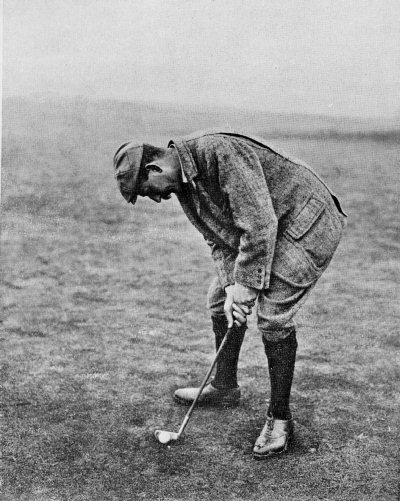
As you can see, he used a very short putter. And here's another view:
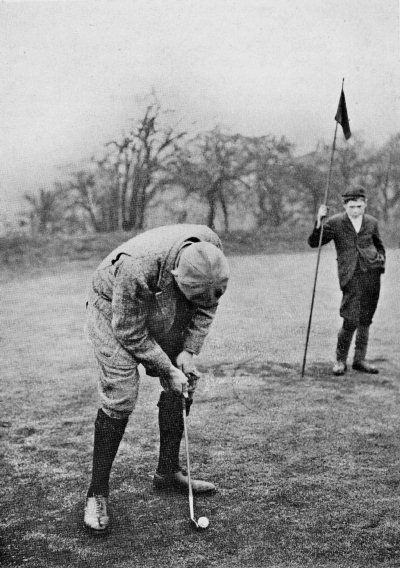
Vardon's refusal to give any measurements or diagrams regarding his stance is significant. Throughout his book, he is almost neurotic in his attention to detail when it comes to describing what he does and how he executes the various shots he plays. To simply say that 'putting is an individual matter and you'll just have to find what feels natural to you' is an amazing concession on his part!
His advice on how to find this natural stroke is also amazing, since it shows considerable insight. Think about this, folks: We often talk about how children putt better than most adults, and they get worse as they get older and develop 'scar tissue' from missed putts. Vardon's logic here is simple: Children putt better because their minds aren't full of other people's advice! They just putt the way that seems most logical to them. And Vardon says that's how you have to find your natural stroke:
Instead of thinking about how to putt, you should be thinking only about getting the ball in the hole, period. And notice that, later in the piece, he specifically says that you can't consciously try to standardize your stroke based on the days you putt well: it's all about comfort. And that makes sense, because you're human and your body feels a bit different each day, so if you could get in the exact same position each day, some days you'd putt well and some days you wouldn't because you still wouldn't feel right all the time.
Sounds like mysticism, doesn't it? That's why Vardon's method is not taught these days, but quantifiable technique is. Note that Vardon DOES say that, when your putting goes bad, it's probably because of a change in your stance. That's because your stance is your only connection to the ground and such a change would affect your balance, how you reach for the ball, the tension in your muscles, and so on.
And if you read on in that second paragraph, Vardon goes to far as to suggest that players get distracted by every little thing around them when they putt simply because they aren't comfortable over the ball that day.
Yes, this is only two paragraphs from the book, which is in the public domain here in the US. I'll try to pull out the best ideas at the end of this post, but there's considerable value in wading through Vardon's somewhat longwinded prose. Here is his advice on how to set up for a typical putt and how to think about the stroke itself.
For the proper playing of the other strokes in golf, I have told my readers to the best of my ability how they should stand and where they should put their feet. But except for the playing of particular strokes, which come within the category of those called "fancy," I have no similar instruction to offer in the matter of putting. There is no rule, and there is no best way. Sometimes you see a player bend down and hold the putter right out in front of him with both wrists behind the shaft. This is an eccentricity, but if the player in question believes that he can putt better in this way than in any other, he is quite justified in adopting it, and I would be the last to tell him that he is wrong. The fact is that there is more individuality in putting than in any other department of golf, and it is absolutely imperative that this individuality should be allowed to have its way. I believe seriously that every man has had a particular kind of putting method awarded to him by Nature, and when he putts exactly in this way he will do well, and when he departs from his natural system he will miss the long ones and the short ones too. First of all, he has to find out this particular method which Nature has assigned for his use. There ought not to be much difficulty about this, for it will come unconsciously to his aid when he is not thinking of anybody's advice or of anything that he has ever read in any book on golf. That day the hole will seem as big as the mouth of a coal mine, and putting the easiest thing in the world. When he stands to his ball and makes his little swing, he feels as easy and comfortable and confident as any man can ever do. Yet it is probable that, so far as he knows, he is not doing anything special. It may happen that the very next day, when he thinks he is standing and holding his club and hitting the ball in exactly the same way, he nevertheless feels distinctly uncomfortable and full of nervous hesitation as he makes his stroke, and then the long putts are all either too short, or too long, or wide, and the little ones are missed.Then Vardon includes these two photos. Unusual stance, huh?
I don't think that the liver or a passing variation in temperament is altogether the cause of this. I believe it is because the man has departed even by a trifle from his own natural stance. A change of the position of the feet by even a couple of inches one way or the other may alter the stance altogether, and knock the player clean off his putting. In this new position he will wriggle about and feel uncomfortable. Everything is wrong. His coat is in the way, his pockets seem too full of old balls, the feel of his stockings on his legs irritates him, and he is conscious that there is a nail coming up on the inside of the sole of his boot. It is all because he is just that inch or two removed from the stance which Nature allotted to him for putting purposes, but he does not know that, and consequently everything in the world except the true cause is blamed for the extraordinary things he does. A fair sample of many others was the clergyman who, having missed a short putt when playing in a match over a Glasgow links, espied in the distance on an eminence fully a quarter of a mile away from the green, an innocent tourist, who was apparently doing nothing more injurious to golf than serenely admiring the view. But the clerical golfer, being a man of quick temper, poured forth a torrent of abuse, exclaiming, "How could I hole the ball with that blockhead over there working his umbrella as if it were the pendulum of an eight-day clock!" When this is the kind of thing that is happening, I advise the golfer to try variations in his stance for putting, effecting the least possible amount of change at a time. There is a chance that at last he will drop into his natural stance, or something very near it, and even if he does not there is some likelihood that he will gain a trifle in confidence by the change, and that will count for much. And anyhow there is ample justification for any amount of manœuvring of the body and the feet when one is off one's putting, for at the best, to make use of something like an Irishism, the state of things is then hopelessly bad, and every future tendency must be in the way of improvement. There is one other suggestion to make to those golfers who believe what I say about the natural stance, and by this time it will have become more or less obvious to them. It is that when they are fairly on their putting, and are apparently doing all that Nature intended them to do, and are feeling contented in body and mind accordingly, they should take a sly but very careful look at their feet and body and everything else just after they have made a successful long putt, having felt certain all the time that they would make it. This examination ought not to be premeditated, because that would probably spoil the whole thing; and it usually happens that when one of these long ones has been successfully negotiated, the golfer is too much carried away by his emotions of delight to bring himself immediately to a sober and acute analysis of how it was done. But sometime he may remember to look into the matter, and then he should note the position of everything down to the smallest detail and the fraction of an inch, and make a most careful note of them for future reference. It will be invaluable. So, as I hold that putting is a matter of Nature and instinct, I make an exception this time to my rule in the matter of illustrations, and offer to my readers no diagram with stance measurements. From the two photographs of myself putting in what I had every reason to believe at the time was my own perfectly natural stance, they may take any hints that they may discover.
As you can see, he used a very short putter. And here's another view:
Vardon's refusal to give any measurements or diagrams regarding his stance is significant. Throughout his book, he is almost neurotic in his attention to detail when it comes to describing what he does and how he executes the various shots he plays. To simply say that 'putting is an individual matter and you'll just have to find what feels natural to you' is an amazing concession on his part!
His advice on how to find this natural stroke is also amazing, since it shows considerable insight. Think about this, folks: We often talk about how children putt better than most adults, and they get worse as they get older and develop 'scar tissue' from missed putts. Vardon's logic here is simple: Children putt better because their minds aren't full of other people's advice! They just putt the way that seems most logical to them. And Vardon says that's how you have to find your natural stroke:
...he has to find out this particular method which Nature has assigned for his use. There ought not to be much difficulty about this, for it will come unconsciously to his aid when he is not thinking of anybody's advice or of anything that he has ever read in any book on golf. That day the hole will seem as big as the mouth of a coal mine, and putting the easiest thing in the world.Unconscious putting -- a simple concept that goes against most modern instruction. Too much practice inhibits unconscious technique. And make no mistake about it, your 'natural stroke' is a technique; it's just not based on "I need to hold the club like this and stroke on this path and keep my wrists in this position at impact."
Instead of thinking about how to putt, you should be thinking only about getting the ball in the hole, period. And notice that, later in the piece, he specifically says that you can't consciously try to standardize your stroke based on the days you putt well: it's all about comfort. And that makes sense, because you're human and your body feels a bit different each day, so if you could get in the exact same position each day, some days you'd putt well and some days you wouldn't because you still wouldn't feel right all the time.
Sounds like mysticism, doesn't it? That's why Vardon's method is not taught these days, but quantifiable technique is. Note that Vardon DOES say that, when your putting goes bad, it's probably because of a change in your stance. That's because your stance is your only connection to the ground and such a change would affect your balance, how you reach for the ball, the tension in your muscles, and so on.
And if you read on in that second paragraph, Vardon goes to far as to suggest that players get distracted by every little thing around them when they putt simply because they aren't comfortable over the ball that day.
Which means that Vardon's guiding principle for putting is that you should feel comfortable when you stand over the ball, no matter what your technique looks like when you do. Because he says that is probably your natural way of putting, and therefore it's the method that will likely give you the most success.I'll stop there. There is so much about the mindset of putting that can be gleaned from these two lengthy paragraphs! Even sports psychologists could find some useful material here. So I'll leave it to you, to search for clues that might help you improve your own putting.
Friday, May 18, 2018
A Couple More Putting Thoughts from Harry Vardon
Yesterday I posted a long quote from Harry Vardon about putting and, while I intend to explore some of the other things he wrote about putting soon, there are a couple of other things in that long quote that are worth looking at as well. I didn't cover them yesterday because the quote was so long!
 One of those things has to do with practice, and this might surprise you. You see, Vardon wasn't a big fan of putting practice:
But Vardon does seem to contradict himself, doesn't he? He starts by expressing his disbelief in that old "golfers are born, not made" saying, yet he doesn't believe a lot of practice will help you get better either -- although he says learning proper technique won't hurt.
As you'll see -- in that future post that won't be long in coming -- Vardon is a big believer that every player putts best when they putt in their own way, the way that feels most natural to them. Putting is different from the other strokes in golf, where certain techniques are necessary in order to get the ball to fly a specified distance or bounce in a specified way. If you're putting properly, the ball isn't going to fly or bounce! It takes no special skill to simply hit the ball so it rolls on the ground, and that's all a putt should do.
So I think you'll be pleasantly surprised at how simple Vardon's putting advice is when I post it. It's more about how to fix problems that prevent you from hitting the ball smoothly rather than learning techniques about how to hit the ball.
The other thing I want to point out from yesterday's quote concerns experience. Bear in mind that when Vardon wrote the book this quote came from, he had already won five majors:
Why doesn't experience help us all the time when we putt?
The simple fact is that we don't control as much when we putt as we would like to believe. Blades of grass are as individual as fingerprints. Here, take a look at a single grass plant in this diagram from the Lawn Institute:
That's a pretty complex organism you're looking at there! Add the variables of grass type, moisture, length, growth direction (they grow toward the sun, you know -- that's called grain), the fact that no piece of ground is perfectly smooth, etc., and you'll soon realize that you can't predict the exact path of the ball with any certainty. All the experience in the world won't make you able to predict the path with the accuracy you'd like to expect.
Now perhaps you can understand why Vardon says that fear is a bigger problem than technique. A confident stroke is more likely to track along the path you choose than a hesitant stroke, as grain has the most effect on your ball as it loses speed. And the inexperienced player, who doesn't realize how many variables can affect his putt, simply steps up and hits the ball firmly -- often too firmly -- and as a result the ball tracks along much better and gives him a better chance that the ball will drop.
Assuming the new player made a decent stroke on a reasonable line, that is. As Vardon says, nothing is certain in putting.
So hopefully the extended quote from Vardon in yesterday's post makes a bit more sense now. And when I put up the next post containing his advice -- probably early next week -- this may help you get the most good from it.
One of those things has to do with practice, and this might surprise you. You see, Vardon wasn't a big fan of putting practice:While I am not prepared to endorse the opinion that is commonly expressed, that a golfer is born and not made, I am convinced that no amount of teaching will make a golfer hole out long putts with any frequency, nor will it even make him at all certain of getting the short ones down. But it will certainly put him in the right way of hitting the ball, which after all will be a considerable gain."I am convinced that NO AMOUNT of teaching will make a golfer hole out long putts with any frequency, nor will it even make him at all certain of getting the short ones down." Vardon does write about the things he believes WILL help you putt better at a later point in the chapter this quote came from, and we'll get to that in another post.
But Vardon does seem to contradict himself, doesn't he? He starts by expressing his disbelief in that old "golfers are born, not made" saying, yet he doesn't believe a lot of practice will help you get better either -- although he says learning proper technique won't hurt.
As you'll see -- in that future post that won't be long in coming -- Vardon is a big believer that every player putts best when they putt in their own way, the way that feels most natural to them. Putting is different from the other strokes in golf, where certain techniques are necessary in order to get the ball to fly a specified distance or bounce in a specified way. If you're putting properly, the ball isn't going to fly or bounce! It takes no special skill to simply hit the ball so it rolls on the ground, and that's all a putt should do.
So I think you'll be pleasantly surprised at how simple Vardon's putting advice is when I post it. It's more about how to fix problems that prevent you from hitting the ball smoothly rather than learning techniques about how to hit the ball.
The other thing I want to point out from yesterday's quote concerns experience. Bear in mind that when Vardon wrote the book this quote came from, he had already won five majors:
Experience counts for very much, and it will convert a man who was originally a bad putter into one who will generally hold his own on the greens, or even be superior to the majority of his fellows. Even experience, however, counts for less in putting than in any other department of the game, and there are many days in every player's life when he realises only too sadly that it seems to count for nothing at all.Again, we're looking at some apparent doubletalk. Experience can make you a better putter... but it won't help as much as you might hope. It's right after this part of the quote that he starts talking about new players who run putts in from everywhere while you, the experienced player, can't seem to find the hole at all. He also says that fear -- which I focused on in yesterday's post -- is a major reason that experience doesn't always help.
Why doesn't experience help us all the time when we putt?
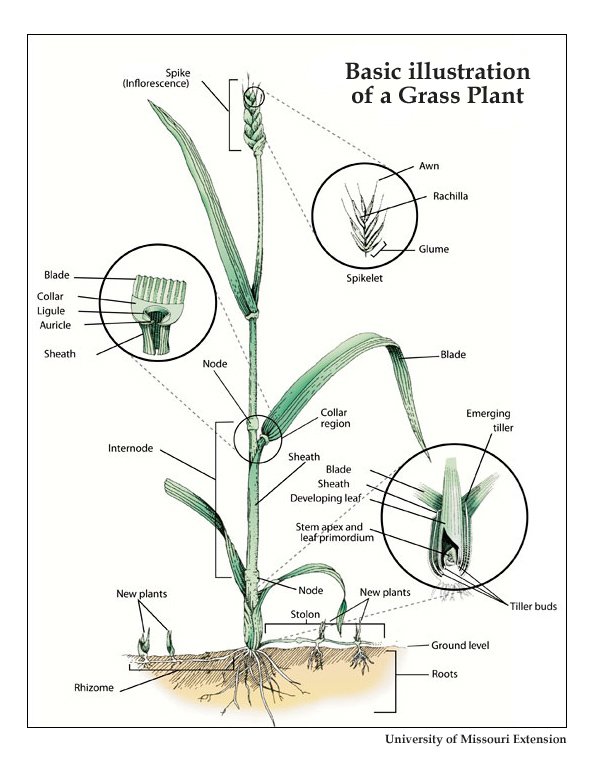
The simple fact is that we don't control as much when we putt as we would like to believe. Blades of grass are as individual as fingerprints. Here, take a look at a single grass plant in this diagram from the Lawn Institute:
That's a pretty complex organism you're looking at there! Add the variables of grass type, moisture, length, growth direction (they grow toward the sun, you know -- that's called grain), the fact that no piece of ground is perfectly smooth, etc., and you'll soon realize that you can't predict the exact path of the ball with any certainty. All the experience in the world won't make you able to predict the path with the accuracy you'd like to expect.
Now perhaps you can understand why Vardon says that fear is a bigger problem than technique. A confident stroke is more likely to track along the path you choose than a hesitant stroke, as grain has the most effect on your ball as it loses speed. And the inexperienced player, who doesn't realize how many variables can affect his putt, simply steps up and hits the ball firmly -- often too firmly -- and as a result the ball tracks along much better and gives him a better chance that the ball will drop.
Assuming the new player made a decent stroke on a reasonable line, that is. As Vardon says, nothing is certain in putting.
So hopefully the extended quote from Vardon in yesterday's post makes a bit more sense now. And when I put up the next post containing his advice -- probably early next week -- this may help you get the most good from it.
Thursday, May 17, 2018
Harry Vardon on the Simple Putt... and Why It's Not So Simple
Harry Vardon's first golf book, The Complete Golfer, was published in 1905 and is in the public domain here in the US. It's a mixture of instruction, memoir and opinion that takes some time to work through. But Vardon set records that still stand today and, in his time, was known as the Greyhound because once he got in the lead he was rarely caught.
This somewhat long quote is from Chapter XIII, Simple Putting, and I haven't even quoted the entire paragraph! But Vardon makes a point here that few players ever seem to realize, and I think it's worth pointing it out.
We are expected to make the short putts, but we know that they won't all go in... and we're afraid that this putt is one of them. We may be afraid that we won't score as we expect, or that we won't score as others expect, or that some other unnamed expectation won't be met, but it all comes down to FEAR.
If we want to become better putters, a major stumbling block is overcoming this fear. But how do you do that?
Vardon has some interesting ideas on how one becomes a better putter later in that chapter, and I'll post some of them soon. But for now I will just mention that your PERSPECTIVE on the game is a major weapon in this battle.
To put it simply, if you are "afraid of the hole," something about the game means too much to you -- that is, you don't see it as a game but as a part of your self-worth. If you want to putt better, THAT HAS TO CHANGE. You have to find a way to put golf back in its place; you have to draw your self-image from something more dependable than golf.
It's as simple -- and as difficult -- as that. But what did you expect? It's golf, after all!
This somewhat long quote is from Chapter XIII, Simple Putting, and I haven't even quoted the entire paragraph! But Vardon makes a point here that few players ever seem to realize, and I think it's worth pointing it out.
Putting in golf is a game within another game. While I am not prepared to endorse the opinion that is commonly expressed, that a golfer is born and not made, I am convinced that no amount of teaching will make a golfer hole out long putts with any frequency, nor will it even make him at all certain of getting the short ones down. But it will certainly put him in the right way of hitting the ball, which after all will be a considerable gain. Experience counts for very much, and it will convert a man who was originally a bad putter into one who will generally hold his own on the greens, or even be superior to the majority of his fellows. Even experience, however, counts for less in putting than in any other department of the game, and there are many days in every player's life when he realises only too sadly that it seems to count for nothing at all. Do we not from time to time see beginners who have been on the links but a single month, or even less than that, laying their long putts as dead as anybody could wish almost every time, and getting an amazing percentage of them into the tin itself? Often enough they seem to do these things simply because, as we should say, they know nothing at all about putting, which is perhaps another way of saying that their minds are never embarrassed by an oppressive knowledge of all the difficulties which the ball will meet with in its passage from the club to the hole, and of the necessity of taking steps to counteract them all. They are not afraid of the hole. The fact is that putting is to a far greater extent than most of us suspect purely a matter of confidence. When a man feels that he can putt he putts, and when he has a doubt about it he almost invariably makes a poor show upon the greens. Do I not know to my cost what it is to feel that I cannot putt, and on those occasions to miss the most absurdly little ones that ever wait to be popped into the hole without a moment's thought or hesitation? It is surely the strangest of the many strange things in golf, that the old player, hero of many senior medal days, victor in matches over a hundred links, will at times, when the fortunes of an important game depend upon his action, miss a little putt that his ten-year-old daughter would get down nine times out of ten. She, dear little thing, does not yet know the terrors of the short putt. Sometimes it is the most nerve-breaking thing to be found on the hundred acres of a golf course. The heart that does not quail when a yawning bunker lies far ahead of the tee just at the distance of a good drive, beats in trouble when there are but thirty inches of smooth even turf to be run over before the play of the hole is ended.Let me call your attention to a couple of sentences in the middle of this quote, where Vardon mentions inexperienced players who make putts that the "more expert" among us don't. Of those inexperienced players he simply says:
They are not afraid of the hole. The fact is that putting is to a far greater extent than most of us suspect purely a matter of confidence.They are not afraid of the hole. As much as we hate to admit it, this is the simple truth. The shorter the putt, the more afraid we become.
We are expected to make the short putts, but we know that they won't all go in... and we're afraid that this putt is one of them. We may be afraid that we won't score as we expect, or that we won't score as others expect, or that some other unnamed expectation won't be met, but it all comes down to FEAR.
If we want to become better putters, a major stumbling block is overcoming this fear. But how do you do that?
Vardon has some interesting ideas on how one becomes a better putter later in that chapter, and I'll post some of them soon. But for now I will just mention that your PERSPECTIVE on the game is a major weapon in this battle.
To put it simply, if you are "afraid of the hole," something about the game means too much to you -- that is, you don't see it as a game but as a part of your self-worth. If you want to putt better, THAT HAS TO CHANGE. You have to find a way to put golf back in its place; you have to draw your self-image from something more dependable than golf.
It's as simple -- and as difficult -- as that. But what did you expect? It's golf, after all!
Friday, April 27, 2018
"The Damn Media"
Today is a link to Ryan Lavner's GC article about David Duval and Jim Furyk's first round 65 at the Zurich Classic. It's both humorous -- the title of my post is Duval's remark to Furyk as he went to meet the media after their round -- and informative, which I want to tell you about here.
One thing that leapt out at me from Lavner's article was how Duval's perspective about his game has changed over the years.
Duval also mentions that the main reason he's playing this week is because he just wanted to get together with Furyk and play some ball. It's okay to play for fun, folks. Let the world gripe about how you play all they want; if you enjoy it, who cares what they think?
I suspect that was on Duval's mind when he made the comment about "the damn media." He knew that, as a general rule, the media has no concept of golf as something fun. It's something to be analyzed, dissected and criticized -- after all, how many times have you heard a commentator say something like "that shot wasn't up to his standards" after the pro didn't hit the ball as close as he said he should?
I always wonder how they can be so sure; perhaps the player didn't feel good over the shot and was actually quite happy that the shot could even found. We all have days like that! And taking Duval's advice might help you reach that happy place as well.
In any case, it seems that Duval and Furyk are quite happy with their play. After one round they're T21 in a field of 80 teams. It seems that "not being perfect" works pretty well.
Whether "the damn media" gets it or not.
One thing that leapt out at me from Lavner's article was how Duval's perspective about his game has changed over the years.
"When you don’t play a lot and you don’t have that opportunity, you feel like you have to play perfectly,” he said. “Being on the other side of the desk, you see how many crappy golf shots really, truly get hit, and it’s like, look, you don’t have to be perfect. You just have to hit more good ones than bad ones and go from there."That's the kind of thing we all should learn from. This is a former #1, a pro who took that title from Tiger Woods, and then had it all taken from him by health and technical problems. "You don't have to be perfect" is a phrase that we should engrave on every club and print on every golf ball we own. Just figure out how to hit more good shots than bad shots and work with that.
Duval also mentions that the main reason he's playing this week is because he just wanted to get together with Furyk and play some ball. It's okay to play for fun, folks. Let the world gripe about how you play all they want; if you enjoy it, who cares what they think?
I suspect that was on Duval's mind when he made the comment about "the damn media." He knew that, as a general rule, the media has no concept of golf as something fun. It's something to be analyzed, dissected and criticized -- after all, how many times have you heard a commentator say something like "that shot wasn't up to his standards" after the pro didn't hit the ball as close as he said he should?
I always wonder how they can be so sure; perhaps the player didn't feel good over the shot and was actually quite happy that the shot could even found. We all have days like that! And taking Duval's advice might help you reach that happy place as well.
In any case, it seems that Duval and Furyk are quite happy with their play. After one round they're T21 in a field of 80 teams. It seems that "not being perfect" works pretty well.
Whether "the damn media" gets it or not.
Tuesday, April 24, 2018
David Ogrin's Burned Popcorn Theory (Video)
Greetings from almost sunny Orlando! Some friends invited me to join them for a week in Disneyworld, and how could I say no? The big question becomes one of getting my blogs done on time without slowing the group down.
Today I have a simple video from GC that centers on one simple thought -- which is all I can handle after a day of travel! This is GCA Coach David Ogrin's "burned popcorn" theory, a POST-shot routine that I really like.
What I love about this "theory" is that it gets rid of the idea of "fixing" a bad swing. When you burn popcorn, it's done for and all you can do is toss the batch and start fresh.
STARTING FRESH are the key words here.
Forget the bad swing entirely. You can't take it back. Instead of asking, "what did I do wrong?" you need to ask "what can I do differently?" This is an extremely positive way of approaching game improvement. There is no self-incrimination, no beating yourself up -- just a simple, constructive question that helps you understand what you need to do to get the results you want.
If you want to improve, figure out how to get the results you want. That's the most direct route to lower scores, and that's the one you want to take.
Today I have a simple video from GC that centers on one simple thought -- which is all I can handle after a day of travel! This is GCA Coach David Ogrin's "burned popcorn" theory, a POST-shot routine that I really like.
What I love about this "theory" is that it gets rid of the idea of "fixing" a bad swing. When you burn popcorn, it's done for and all you can do is toss the batch and start fresh.
STARTING FRESH are the key words here.
Forget the bad swing entirely. You can't take it back. Instead of asking, "what did I do wrong?" you need to ask "what can I do differently?" This is an extremely positive way of approaching game improvement. There is no self-incrimination, no beating yourself up -- just a simple, constructive question that helps you understand what you need to do to get the results you want.
If you want to improve, figure out how to get the results you want. That's the most direct route to lower scores, and that's the one you want to take.
Friday, April 13, 2018
The New Patrick Reed Mental Game
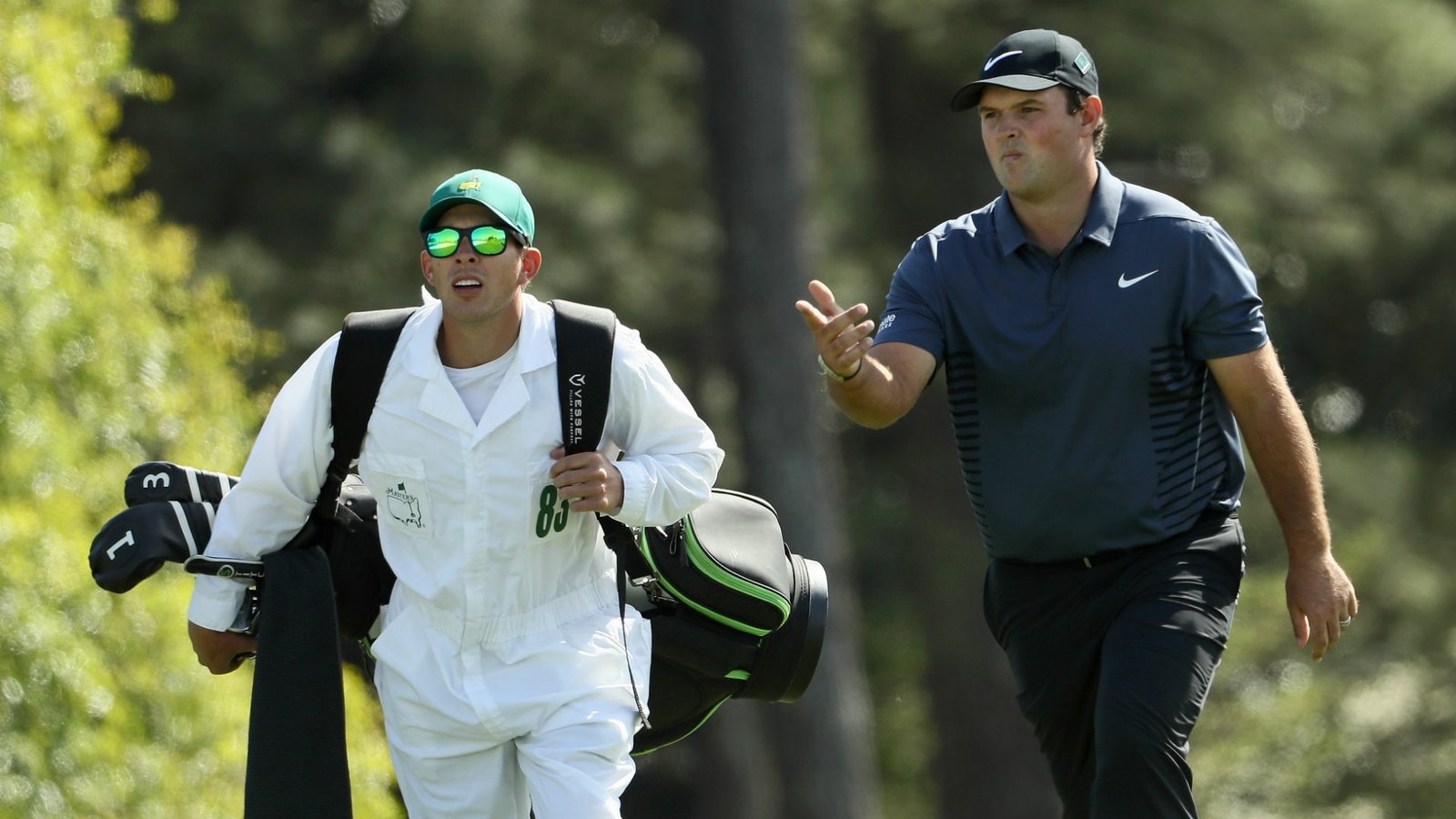
Today I'm linking you to Tim Rosaforte's GC article on how Patrick Reed prepared for the Masters last week. This is a more detailed look at the process he followed than the What Patrick Reed Did Differently This Week post I put up last week.
Here's something that particularly stood out to me:
The article is an in-depth interview with Reed's coach Kevin Kirk, and it's a great reminder of how tough it can be at Augusta. Reed enlisted the sports psychologist who helped the NBA's Golden State Warriors win their two recent World Championships in 2015 and 2017. And Rosaforte has details on Reed's practice sessions and such.
A fascinating read (Reed?) about how a guy that few gave a chance to win became the newest Masters champion. Great work by Tim Rosaforte.
Here's something that particularly stood out to me:
These were not the typical practice sessions you see before major championships. Instead of playing the course, they walked the course, letting groups play through. Kirk estimates that Reed only hit 30 shots, but must have putted 5,000 times in the eight-hour shift on Wednesday. Reed took copious notes in his yardage book, indicating the pin placements, fall lines, wind directions and the best shot shapes for every scenario. At 7 p.m. ET, one of the club’s assistant pros came out to politely inform them that the course was closed. As Kirk remembered it, “The kid said, ‘I hate to tell you this, but I’ve got to ask you guys to leave.’”Only 30 shots, but thousands of putts over eight hours! That's some serious prep on the greens.
The article is an in-depth interview with Reed's coach Kevin Kirk, and it's a great reminder of how tough it can be at Augusta. Reed enlisted the sports psychologist who helped the NBA's Golden State Warriors win their two recent World Championships in 2015 and 2017. And Rosaforte has details on Reed's practice sessions and such.
A fascinating read (Reed?) about how a guy that few gave a chance to win became the newest Masters champion. Great work by Tim Rosaforte.
Saturday, April 7, 2018
What Patrick Reed Did Differently This Week
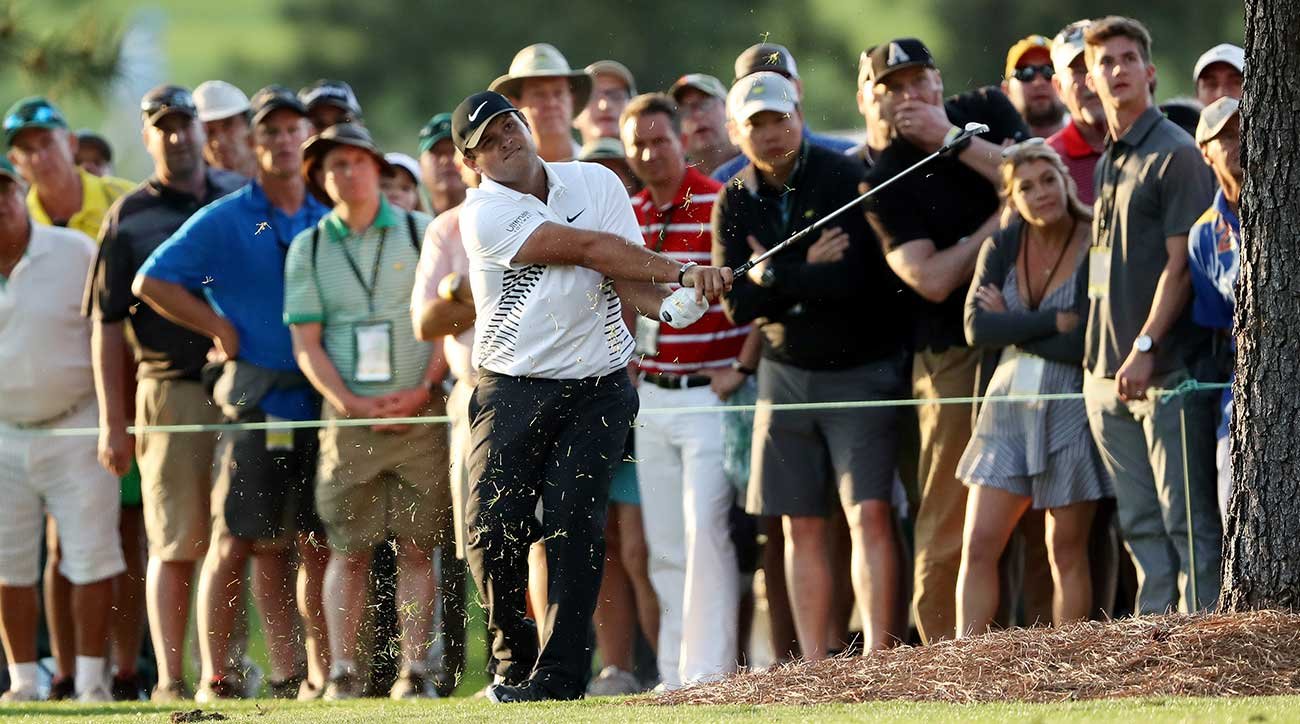
Golf Magazine posted an article late Friday examining why Patrick Reed is playing better in this Masters than in past majors. It's an interesting look at how his preparation has changed after a talk with his coach, Kevin Kirk. I'm going to pull a couple of quotes for this post.
Early on, the article quotes Kirk:
But, as you no doubt have guessed, you'll need to read the article to get all that. And in the process, you just might pick up a few pointers you can use in your own game.
Early on, the article quotes Kirk:
"I told him in Mexico that his golf game reminds me of when someone leaves an oven on in a house," said his coach Kevin Kirk, who has grooved Reed's swing since 2011. "All you have to do is light a match."Later on, we learn what happened when Reed arrived at Augusta:
With his swing clicking, he arrived in town last week, and rather than killing time on mechanics, he and his coach took a deeper dive on the course itself. On Reed's first practice day at Augusta, he spent eight hours on the course but played just four holes: 1, 2, 12 and 13. "We read the slopes, practiced at the pin positions, formed plans for different winds," Kirk said. "In his mind, he's ready."There's a lot more to Reed's preparation than just focusing on four holes, of course. He arrived at the course last Friday and has been at work ever since. The article goes into a fair amount of detail about the strategic work he did, as well as his mindset for using that strategy this weekend.
But, as you no doubt have guessed, you'll need to read the article to get all that. And in the process, you just might pick up a few pointers you can use in your own game.
Tuesday, April 3, 2018
Things We Can Learn from Pernilla Lindberg
I hope you all got to watch Pernilla Lindberg and Inbee Park's final four holes on Monday morning. It was pretty impressive, especially as Pernilla continued to make critical putt after critical putt, finally sinking a long one at the 10th hole (playoff hole #8). Inbee finally flinched, giving Pernilla the win.

Her caddy, who also happens to be her fiance Daniel Taylor, was also pretty impressive as he dove headfirst into Poppie's Pond.

Anyway, I thought I'd take a quick look at some things we can learn from Pernilla. First, a look at her pre-shot routine.
Those of you who follow my blog regularly probably know that I'm not a big fan of pre-shot routines -- I think they have become an excuse to avoid hitting your shot. Pernilla's is different though. She seems to use her routine almost purely to get her alignment correct.
I looked all over for a video of her current routine and couldn't find one. This video from 2014 is a little different but it's the best I could do, and you really only see her routine twice -- once at the beginning of the video and once at the end. Still, you can see that she sets her ball position, then spreads her feet, lifts her club and bumps her lead hip toward the target, then addresses the ball and makes her swing.
Her current "club lift and hip bump" is a bit more formal, and she uses a couple more club lifts instead of a waggle, but this is essentially the same that she did before each wood and hybrid shot all week. (She doesn't bump her hip on the irons, probably because she's more concerned with accuracy than distance when hitting those clubs.)
You can also learn from her strategy. She (and Inbee too, for that matter) played each hole almost the same each time through, both in the regular tournament and in the playoff. The only variation I recall happened on the 7th playoff hole Monday morning -- that's the par-5 18th -- where Pernilla got her drive close enough to go for the green in two. She didn't get close enough for a realistic chance for eagle, but she did put the ball safely on the green and walked away with a two-putt birdie.
In other words, she played smart. She played to her strengths and, when she did play an aggressive shot, she missed it in the correct spot so she kept herself in the game.
Finally, her mindset was amazing. Pernilla said she figured out early on that she was the underdog, so she figured she had nothing to lose. She took this as both an opportunity and an honor. She decided to enjoy her chance and just kept grinding. Terry and Judy said it on Monday morning -- even if Pernilla didn't win, she had proven herself and won so much respect that her future in the game would be different anyway!
And when Inbee missed the putt that would have sent the playoff to a 9th hole, Pernilla was visibly shocked. She said afterward that she just assumed Inbee would make the putt, and she was already planning her tee shot for the next hole.
When Inbee missed, Pernilla Lindberg pulled off one of the biggest upsets in recent golf history. And now you know some of the reasons why she did.
Let me add just one more thought on Pernilla's amazing mindset. While most viewers will believe it came from nowhere, it didn't. No doubt many of you will have heard that you "need to pay your dues" before you can earn a win like this. Perhaps that's true.
But "dues" don't have to be "paid" in the same place where they are collected, if you follow what I'm saying.
Business people recognize what they call "transferable skills," which simply means that many seemingly unrelated professions use similar skills. A mother who manages a household with a husband and three kids, planning all the meals and coordinating all the schedules, may turn out to be a skilled office manager. The skills needed for both are essentially the same.
In much the same way, "dues paid" in one area of life can be applied in other areas as well. After all, patience and persistence and the ability to handle pressure are necessary skills in many areas of life, not just golf And once you add Pernilla's considerable experience as a college golfer -- plus her time as a competitive downhill skier, which many folks don't remember -- she's been in some pretty big arenas before, places where those dues would have been paid.
So remember that when you think you can't handle things out on the golf course. You may have more usable experience to draw on than you realize.
The only difference between Pernilla and you is that she knew she had paid her dues.
Her caddy, who also happens to be her fiance Daniel Taylor, was also pretty impressive as he dove headfirst into Poppie's Pond.
Anyway, I thought I'd take a quick look at some things we can learn from Pernilla. First, a look at her pre-shot routine.
Those of you who follow my blog regularly probably know that I'm not a big fan of pre-shot routines -- I think they have become an excuse to avoid hitting your shot. Pernilla's is different though. She seems to use her routine almost purely to get her alignment correct.
I looked all over for a video of her current routine and couldn't find one. This video from 2014 is a little different but it's the best I could do, and you really only see her routine twice -- once at the beginning of the video and once at the end. Still, you can see that she sets her ball position, then spreads her feet, lifts her club and bumps her lead hip toward the target, then addresses the ball and makes her swing.
Her current "club lift and hip bump" is a bit more formal, and she uses a couple more club lifts instead of a waggle, but this is essentially the same that she did before each wood and hybrid shot all week. (She doesn't bump her hip on the irons, probably because she's more concerned with accuracy than distance when hitting those clubs.)
You can also learn from her strategy. She (and Inbee too, for that matter) played each hole almost the same each time through, both in the regular tournament and in the playoff. The only variation I recall happened on the 7th playoff hole Monday morning -- that's the par-5 18th -- where Pernilla got her drive close enough to go for the green in two. She didn't get close enough for a realistic chance for eagle, but she did put the ball safely on the green and walked away with a two-putt birdie.
In other words, she played smart. She played to her strengths and, when she did play an aggressive shot, she missed it in the correct spot so she kept herself in the game.
Finally, her mindset was amazing. Pernilla said she figured out early on that she was the underdog, so she figured she had nothing to lose. She took this as both an opportunity and an honor. She decided to enjoy her chance and just kept grinding. Terry and Judy said it on Monday morning -- even if Pernilla didn't win, she had proven herself and won so much respect that her future in the game would be different anyway!
And when Inbee missed the putt that would have sent the playoff to a 9th hole, Pernilla was visibly shocked. She said afterward that she just assumed Inbee would make the putt, and she was already planning her tee shot for the next hole.
When Inbee missed, Pernilla Lindberg pulled off one of the biggest upsets in recent golf history. And now you know some of the reasons why she did.
Let me add just one more thought on Pernilla's amazing mindset. While most viewers will believe it came from nowhere, it didn't. No doubt many of you will have heard that you "need to pay your dues" before you can earn a win like this. Perhaps that's true.
But "dues" don't have to be "paid" in the same place where they are collected, if you follow what I'm saying.
Business people recognize what they call "transferable skills," which simply means that many seemingly unrelated professions use similar skills. A mother who manages a household with a husband and three kids, planning all the meals and coordinating all the schedules, may turn out to be a skilled office manager. The skills needed for both are essentially the same.
In much the same way, "dues paid" in one area of life can be applied in other areas as well. After all, patience and persistence and the ability to handle pressure are necessary skills in many areas of life, not just golf And once you add Pernilla's considerable experience as a college golfer -- plus her time as a competitive downhill skier, which many folks don't remember -- she's been in some pretty big arenas before, places where those dues would have been paid.
So remember that when you think you can't handle things out on the golf course. You may have more usable experience to draw on than you realize.
The only difference between Pernilla and you is that she knew she had paid her dues.
Saturday, March 31, 2018
Raymond Floyd on Feeling the Target
With all the talk about mental mistakes at the LPGA and PGA Tour events on Friday, I thought it might be worthwhile to look at what Raymond Floyd had to say about the mental game. In his book The Elements of Scoring he has an entire chapter called Let Your Mind Feel the Target that deals with this topic.
Obviously I can't quote an entire chapter! But there are a couple of things he says that I think you could use immediately in your own golf games.
To begin with, he says that we may have the wrong idea about what it means to "play with feel." While it does involve what you feel with your hands to some degree, Floyd says he thinks you use your eyes to play with feel. Things like recognizing shot shapes, improvising swings in tough situations, and such are based on things you see, not things you can touch. He believes this is why so many pros have begun using mental coaches —you need to get out of your own way and give your mind more freedom, more trust to make the right decisions.
Then he says this about what we commonly call "target golf":
And I'm not even sure he's talking about visualization here. I haven't thrown any spears that I can remember, but I have thrown baseballs and discs and hit a few tennis shots and made a few free throws on a basketball court. I can't say that I actually visualize those actions. Rather, I identify my target and anything that might be in the way that I have to avoid, and then I just think about hitting my target. There must be some visualizing in there — I'm seeing things I have to avoid, after all — but it's not a conscious act. I just notice them.
I suspect that's part of why so many of us have trouble with target golf. We try to see lines curving through the sky and other things like that. But that may have the same effect as too many words. Perhaps we just need to "see and do." That certainly sounds like what Floyd is suggesting.
Here's an idea: Next time you need to play a shot — say, a low shot — just try swinging the club at an imaginary ball and imagine the ball coming off the face low when you swing. I bet your hands and arms will adjust to create the shot. If you then try to duplicate that shot without an undue amount of thought, you might pull it off. Maybe not the first time, because learning to play by feel comes from practice. But you might be more successful than you expect.
No lines curving through space, no elaborate body positioning. Just pretend you're Bubba. Playing that game on the range might teach you some new things about shotmaking.
Obviously I can't quote an entire chapter! But there are a couple of things he says that I think you could use immediately in your own golf games.
To begin with, he says that we may have the wrong idea about what it means to "play with feel." While it does involve what you feel with your hands to some degree, Floyd says he thinks you use your eyes to play with feel. Things like recognizing shot shapes, improvising swings in tough situations, and such are based on things you see, not things you can touch. He believes this is why so many pros have begun using mental coaches —you need to get out of your own way and give your mind more freedom, more trust to make the right decisions.
Then he says this about what we commonly call "target golf":
As a scorer, your goal on the course should be to just play golf. Even though golf is a slow game that allows plenty of time to think, from the moment you begin your pre-shot routine, you want a clear mind that is thinking only of the simple task at hand, which is to hit the ball to the target. In this state, the body is relaxed, and the focus is strictly on where — not how — you want to hit the ball. Imagine a very hungry caveman throwing a spear at his prey. I seriously doubt he had any thoughts about his release point or how high to carry his right elbow. I'll bet he was thinkingNote what he says: "I'm not saying golf should be played with a blank mind. Far from it." Clearing your mind isn't about playing thoughtless golf. But instead of filling your mind with lots and lots of words about how you should do this and how you should do that, you want to fill your mind with a clear picture of what you're trying to do.
LET YOUR MIND FEEL THE TARGET
about precisely where he had to throw that spear. If he wasn't "out of his own way," he didn't eat.
I'm not saying golf should be played with a blank mind. Far from it. But rather than having many scattered thoughts, you should have one very focused one. A scorer has control of what he chooses to think of on the golf course. He knows that to a large extent, he is only as good as his thoughts. [p141-142]
And I'm not even sure he's talking about visualization here. I haven't thrown any spears that I can remember, but I have thrown baseballs and discs and hit a few tennis shots and made a few free throws on a basketball court. I can't say that I actually visualize those actions. Rather, I identify my target and anything that might be in the way that I have to avoid, and then I just think about hitting my target. There must be some visualizing in there — I'm seeing things I have to avoid, after all — but it's not a conscious act. I just notice them.
I suspect that's part of why so many of us have trouble with target golf. We try to see lines curving through the sky and other things like that. But that may have the same effect as too many words. Perhaps we just need to "see and do." That certainly sounds like what Floyd is suggesting.
Here's an idea: Next time you need to play a shot — say, a low shot — just try swinging the club at an imaginary ball and imagine the ball coming off the face low when you swing. I bet your hands and arms will adjust to create the shot. If you then try to duplicate that shot without an undue amount of thought, you might pull it off. Maybe not the first time, because learning to play by feel comes from practice. But you might be more successful than you expect.
No lines curving through space, no elaborate body positioning. Just pretend you're Bubba. Playing that game on the range might teach you some new things about shotmaking.
Friday, March 30, 2018
Xander Schauffele on Hitting It Long
Xander Schauffele did an article for Golf Digest on some of his tips for getting big distance when you're a smaller person. You can follow the link to learn some of his tips and feels, but I want to point out one specific thing he says which is different from what you may have heard most instructors say.

Xander uses a neutral grip, which goes against the advice most instructors give -- that is, that a strong grip makes for a more powerful strike. But Xander's definition of a neutral grip is very interesting. Here's what he says:
He says these things will help you to get better hand action so you hit the ball farther. He certainly ought to know!
There are several interesting ideas in Xander's article, but this one about the grip really stood out to me. It's pretty clear that Xander is trying to move freely, not "hold" anything in an attempt to create some special position. That mindset change in and of itself might help you get more distance than you do now.
Xander uses a neutral grip, which goes against the advice most instructors give -- that is, that a strong grip makes for a more powerful strike. But Xander's definition of a neutral grip is very interesting. Here's what he says:
One thing that will help you unleash that power at the right moment is your grip. Mine is neutral. For a stock shot, I see only one knuckle on my glove hand when I look down. This grip allows me to hit draws or fades when I want to. It also lets me release the clubhead into the ball like I’m hammering that nail. If your grip is too strong, you can’t fully release the clubhead, typically resulting in a loss of speed. And a grip that’s too weak makes it tough to square the clubface at impact, so you lose control.You get that? He can only see ONE knuckle, not two or three. Take a good look at that photo above from the article. Xander also notes that he wants to club shaft almost vertical at address for a drive, not leaning forward. That's important because it works with the one-knuckle grip to get the hands in the proper position at impact. Make sure you read what he says about the one-knuckle grip, shaft lean and ball position at address so you don't turn your grip too weak.
He says these things will help you to get better hand action so you hit the ball farther. He certainly ought to know!
There are several interesting ideas in Xander's article, but this one about the grip really stood out to me. It's pretty clear that Xander is trying to move freely, not "hold" anything in an attempt to create some special position. That mindset change in and of itself might help you get more distance than you do now.
Sunday, March 25, 2018
Dr. Patrick Cohn on Escaping Comfort Zones (Video)
I've mentioned Patrick Cohn on this blog before. I have a sports psych book he wrote called Going Low.
Today I found a video he did that briefly covers some mental "tricks" to help you break out of a scoring rut. It's ten years old but the advice is still surprisingly useful.
Cohn defines what a comfort zone is and how it can limit you. Then he gives you some tactics for overcoming those limitations. Although the video says it has three mental strategies, there are really four:
At any rate, the video has some useful info that might help you get out of your own way and maybe break through your own scoring limit. And there's no sign-up form before you can listen!
Today I found a video he did that briefly covers some mental "tricks" to help you break out of a scoring rut. It's ten years old but the advice is still surprisingly useful.
Cohn defines what a comfort zone is and how it can limit you. Then he gives you some tactics for overcoming those limitations. Although the video says it has three mental strategies, there are really four:
- Don't set a target score
- Don't keep track of your score
- Don't play defense -- stay on the attack
- Focus on what you want to do, not what you're afraid you might do
At any rate, the video has some useful info that might help you get out of your own way and maybe break through your own scoring limit. And there's no sign-up form before you can listen!
Sunday, March 18, 2018
Inbee Park Proves That Length Is Overrated (Video)
Inbee Park missed several months with back pain and considered quitting the game. But she decided to keep playing.
And now she's leading the Bank of Hope Founders Cup as if she hadn't missed a beat. She even had a 59 watch going for a while on Saturday. That tends to happen when you're six-under after five holes.
You might want to read Randall Mell's article over at golfchannel.com about the last few months of her life. It's very interesting. And the video here lets you hear a bit of how she's thinking right now.
But what fascinates me is how she continues to blow her competition away when she's not as long as the big guns. In one round this week she was playing from 40 to 50 yards behind her opponents.
And this is something that weekend players should learn from.
Look, I'm not saying that length isn't an advantage. It can certainly help you post a low score if you're able to capitalize on it. But even among the pros, length doesn't make most players into contenders. DJ and Justin Thomas are the exceptions, not the rule. And unlike Tiger in his heyday, even they haven't proven they can win as consistently as the Big Cat did. I mean, DJ has won every year for over a decade now... but Tiger won five times a year for over a decade.
The players who win consistently are the players who learn to take what they have and post a good score with it. That's a matter of mindset ("I can compete with these other players") and strategy ("My game allows me to do these things really well"). And even if you can't knock the cover off the ball, you can learn to capitalize on your strengths by playing smart.
It's still working for Inbee Park. And while she doesn't win all the time, wouldn't it be wild if it worked today?
I'm not betting against her.
And now she's leading the Bank of Hope Founders Cup as if she hadn't missed a beat. She even had a 59 watch going for a while on Saturday. That tends to happen when you're six-under after five holes.
You might want to read Randall Mell's article over at golfchannel.com about the last few months of her life. It's very interesting. And the video here lets you hear a bit of how she's thinking right now.
But what fascinates me is how she continues to blow her competition away when she's not as long as the big guns. In one round this week she was playing from 40 to 50 yards behind her opponents.
And this is something that weekend players should learn from.
Look, I'm not saying that length isn't an advantage. It can certainly help you post a low score if you're able to capitalize on it. But even among the pros, length doesn't make most players into contenders. DJ and Justin Thomas are the exceptions, not the rule. And unlike Tiger in his heyday, even they haven't proven they can win as consistently as the Big Cat did. I mean, DJ has won every year for over a decade now... but Tiger won five times a year for over a decade.
The players who win consistently are the players who learn to take what they have and post a good score with it. That's a matter of mindset ("I can compete with these other players") and strategy ("My game allows me to do these things really well"). And even if you can't knock the cover off the ball, you can learn to capitalize on your strengths by playing smart.
It's still working for Inbee Park. And while she doesn't win all the time, wouldn't it be wild if it worked today?
I'm not betting against her.
Monday, January 29, 2018
Two Promising Returns to Action
The Limerick Summary is delayed because the Farmers playoff resumes this morning at 11am ET. So I'm doing Tuesday's post a day early.
It's been at least a year since both Tiger Woods and Rory McIlroy were healthy enough to make their presence felt on the world.stage. Now we've seen each play in two events -- Tiger in the Bahamas and at Torrey, Rory at Abu Dhabi and Dubai -- and 2018 looks promising for each.
Tiger's play at Torrey this past week has been -- and will continue to be -- analyzed ad nauseam. But the results are pretty clear to anyone willing to look. Despite problems with his full shots in general and his driving in particular, Tiger managed to make his first cut since the Windham in 2015. Who didn't make it? Here are a few names you may recognize:
Not only that, but he laid to rest most of the questions about his short game and putting. He also answered those who doubted he still had the will to grind, the desire to do his best no matter how hard the road. And now he has a couple of weeks to work on the things he learned this week (like bad driving!) before he tees it up at Riviera.
Yes, very promising.
As for Rory, he has a T3 and a runner-up finish in his two starts. That should end the questions about whether he's healthy or not. His game appears to be firing on all cylinders, and he -- like Tiger -- seems to have found his "happy place."
If any question remains unanswered, it's about his ability to close out tournaments... but I don't think that one will last too long. Rory has never been like Tiger -- he's more like Phil. He's streaky and tends to make the occasional bad decision that costs him the win. But he will make fewer of them as he gets back into the rhythm of a full schedule, just as Tiger will make fewer bad shots as he regains his feel for tournament golf.
It's so easy to forget how hard it is to be great, no matter what field you compete in. Tiger noted that Roger Federer picked up his 20th Grand Slam title this weekend at age 36, but 36 is old for a tennis player. Tiger isn't old for a golfer, and Rory even younger, but the challenges for all three are similar. There is always another challenger, one with a different set of skills and something to prove. No matter how talented you are, success is never as easy as it may look. Even the greats like Tiger and Rory need "reps" in order to reach their potential. January is just the beginning of their returns to greatness.
But I suspect it won't be long before the rest of the Tours wish both had stayed on the sidelines a bit longer.
It's been at least a year since both Tiger Woods and Rory McIlroy were healthy enough to make their presence felt on the world.stage. Now we've seen each play in two events -- Tiger in the Bahamas and at Torrey, Rory at Abu Dhabi and Dubai -- and 2018 looks promising for each.
Tiger's play at Torrey this past week has been -- and will continue to be -- analyzed ad nauseam. But the results are pretty clear to anyone willing to look. Despite problems with his full shots in general and his driving in particular, Tiger managed to make his first cut since the Windham in 2015. Who didn't make it? Here are a few names you may recognize:
- Sangmoon Bae
- Jhonattan Vegas
- Ollie Schneiderjans
- Wee Kim
- Xander Schauffele
- Rickie Fowler
Not only that, but he laid to rest most of the questions about his short game and putting. He also answered those who doubted he still had the will to grind, the desire to do his best no matter how hard the road. And now he has a couple of weeks to work on the things he learned this week (like bad driving!) before he tees it up at Riviera.
Yes, very promising.
As for Rory, he has a T3 and a runner-up finish in his two starts. That should end the questions about whether he's healthy or not. His game appears to be firing on all cylinders, and he -- like Tiger -- seems to have found his "happy place."
If any question remains unanswered, it's about his ability to close out tournaments... but I don't think that one will last too long. Rory has never been like Tiger -- he's more like Phil. He's streaky and tends to make the occasional bad decision that costs him the win. But he will make fewer of them as he gets back into the rhythm of a full schedule, just as Tiger will make fewer bad shots as he regains his feel for tournament golf.
It's so easy to forget how hard it is to be great, no matter what field you compete in. Tiger noted that Roger Federer picked up his 20th Grand Slam title this weekend at age 36, but 36 is old for a tennis player. Tiger isn't old for a golfer, and Rory even younger, but the challenges for all three are similar. There is always another challenger, one with a different set of skills and something to prove. No matter how talented you are, success is never as easy as it may look. Even the greats like Tiger and Rory need "reps" in order to reach their potential. January is just the beginning of their returns to greatness.
But I suspect it won't be long before the rest of the Tours wish both had stayed on the sidelines a bit longer.
Friday, January 26, 2018
Gary Player on Dealing with "First Time" Pressure
Today I have a short quote from Gary Player's book Don't Choke. All of us have problems dealing with pressure, and this particular quote addresses the problems that come when you're in a position to do something for the first time.
It's from the first chapter, where he talks about his first major victory in the 1959 Open at Muirfield. He was way back from the lead and finished early. He thought he needed a four on the final hole to win but took a six. It devastated him; he thought he'd lost so he went back to his hotel, only to get a phone call from the course when the rest of the field finished to tell him he had in fact won. The weather was so bad that his overall score was too low for the field to match.
Focus on the opportunity rather than the challenge. It's a simple concept that breeds gratitude... and we should never underestimate the power of gratitude.
It's from the first chapter, where he talks about his first major victory in the 1959 Open at Muirfield. He was way back from the lead and finished early. He thought he needed a four on the final hole to win but took a six. It devastated him; he thought he'd lost so he went back to his hotel, only to get a phone call from the course when the rest of the field finished to tell him he had in fact won. The weather was so bad that his overall score was too low for the field to match.
Breaking through for the first time brings with it a whole different set of pressures. I understood the pressure of Major championship golf. A year before Muirfield, I had finished second in the US Open, and I'd had top-ten finishes in the Open in 1958 and the Masters in 1959. But this was new in terms of dealing with the pressure of trying to become a Major championship winner for the first time in my career.I know that sounds terribly simple. It is, and it's very hard to do. But the point is that many of the most important things we need to learn are also the simplest things. Often our struggles come because we believe that we need to do something complicated in order to succeed... when we really just need to adjust our perspective on things to regain our mental and emotional balance.
It's a case of dealing with the nerves of realizing a dream for the first time. That can be a major obstacle when you want something so badly and have worked all your life to be at that point. The secret is to focus not on the pressure of the situation but rather on the blessing of being in a position to go for your dream. And often, at the moment when it looks as if that dream has fallen to pieces right in front of your eyes, that' s when the phone call comes. [p21]
Focus on the opportunity rather than the challenge. It's a simple concept that breeds gratitude... and we should never underestimate the power of gratitude.
Subscribe to:
Posts (Atom)