ATTENTION, READERS in the 28 EUROPEAN VAT COUNTRIES: Because of the new VAT law, you probably can't order books direct from my site now. But that's okay -- just go to my Smashwords author page.
You can order PDFs (as well as all the other ebook formats) from there.
Showing posts with label flexibility. Show all posts

Thursday, November 30, 2017

Peter Kostis on Jonas Blixt's Golf Swing (Video)

This is a clip from CBS coverage of the 2014 Greenbriar Classic but anytime Peter Kostis compares your swing to Sam Snead's, it's worth a look. Jonas Blixt has been playing well down in Australia so this is as good a time as any.


I'd like to add a couple of observations to what Kostis says.
  • Snead's swing looks more flexible than Blixt's in part because of his equipment. Snead began his career with hickory shafts, which means he learned to create clubhead speed through rhythm rather than power. He focused more on motion than leverage, which is why his swing had a greater range of motion than Blixt's.
  • Facts are, Snead was far more flexible than most modern players, even into his later years. Snead himself said he used yoga stretches as part of his training, and the stories about him are legendary. I've heard more than one of his contemporaries say he could kick the top of a doorjamb from a standing position underneath. (Just for the record, Snead was the first player to use weight training, not Gary Player. The difference is that Snead kept it quiet; he liked to keep his training methods to himself.)
Snead used his flexibility to his advantage. In his teaching (he was originally the Greenbriar's teaching pro, you know) he stressed the need to remain relaxed during your golf swing. That also contributes to the extreme "lag" at the top of his backswing; being so flexible, he could start his downswing while the club was still going back. And by staying so relaxed, he didn't put the stress on his back that so many modern players do.

But there certainly are a number of similarities between Blixt and Snead. While Snead's hips turn more in his backswing and open more in his finish, the movement is rotary not lateral. This is more clearly seen in face-on videos, of which there are many on YouTube. Both men are rotating rather than sliding during their swings, which allows them to return the clubface to the ball more consistently. They don't move back and forth over the ball, so the ball position doesn't change between backswing and downswing.

Blixt is struggling a bit this week at the Australian PGA, perhaps because of all the rain they've had down there. (He was -3 at one point but fell back to even on the back nine while I was watching.) But his swing is fundamentally solid and it surprises me how streaky he is. I suspect he tends to think too much about his mechanics so he's never as relaxed as Snead was. When you have as good a swing as Blixt does, sometimes the best thing you can do is just trust it... and focus on where you want the ball to go.

As he proved with his runner-up finish last week, he's more than capable of getting the job done.

Sunday, May 8, 2016

Annabel Rolley's Chair-Twist Pose for Flexibility

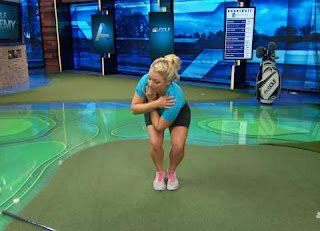
This yoga-style flexibility exercise from Annabel Rolley reminds me of the drill my teacher gave me to teach me how to coil and how to use my legs correctly, all at once. (My stance was wider because we were actually swinging a club, but you get the idea.)


The video explains it in fewer words than I can here, but I snagged this still to help you remember it. Essentially, you put your feet together and squat -- try to keep your feet flat on the floor -- until you're almost in a sitting position. (Your upper body will be leaning forward, of course. Otherwise you'll fall down.) Then you cross your arms across your chest and try to rotate your shoulders -- Martin Hall would say your 'thorax' or chest -- and hold the position briefly before rotating the other way.

Annabel Rolley beginning the twist part of the stretch

This stretch will help you become stronger, more flexible through your back and hips, and also help your balance. Not bad for a single exercise!

Sunday, October 18, 2015

The Most Interesting Woman in Golf?

I discovered this over at golfchannel.com and decided it was just too good to resist.

You want to do that warm-up routine that Miguel Angel Jimenez has become famous for? Here's Annabel Rolley from Golf Channel Academy walking you step by step through the Mechanic's pre-round stretches.


So it seems that there really is method in the Mechanic's madness. But it would have been even more interesting if Annabel had done it with a cigar in her mouth...

Saturday, September 5, 2015

Yes, Jordan Still Crawls

I knew that would get your attention... and yes, I mean Jordan works out with actual crawling movements.

Golf Digest posted this video on Friday. It features Jordan's fitness trainer Damon Goddard demonstrating three exercises that use crawling as a golf exercise.


The three exercises he demonstrates are:
  • Half Bear Crawl
  • Half Crab Reach (a rotation move)
  • Lateral Bear Crawl
These three movements focus on working the opposite sides of your body, which is how most human motion works. (This is Physics 101, folks -- for every action there is an equal and opposite reaction. If the upper left side of your body moves forward, the lower right side also moves forward, and so on.) By working your body this way, they help increase your core and shoulder strength as well as your balance and coordination.

The key thing to remember is that your knees do NOT touch the floor.

I've seen much more elaborate methods of doing these exercises but this is the first time I've seen them done in a small area. But don't let the simplicity of these movements fool you. A useful side effect is that they'll also help your endurance -- trust me, these exercises are harder than they look.

Saturday, August 1, 2015

You Say You Can't Activate Your Glutes?

I simply couldn't resist this. Ron Kaspriske over at Golf Digest posted this video of an exercise to help you learn to activate your glutes -- specifically, the gluteus medius muscles. These are the muscles that help you stabilize your hips so you don't sway or slide during your backswing.

It looks like a pretty simple exercise, and all you need is a stretch band.


Now all you have to do is learn how to keep a straight face when you tell folks you're "activating your glutes."

Friday, July 24, 2015

ATTENTION: Freebie Lessons Alert!

Okay, this is one of the more unusual freebie lesson plans I've seen done by any magazine, so I HAVE to share it with you.

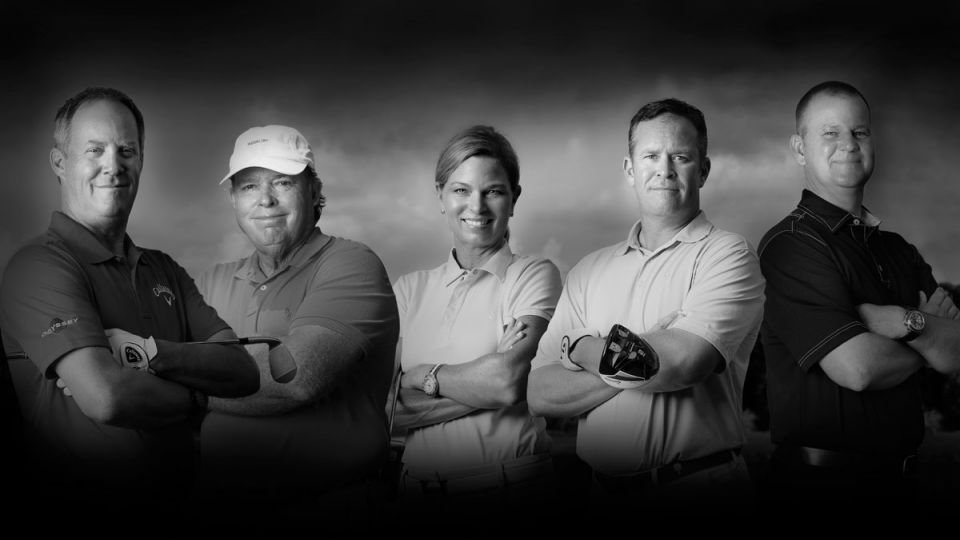
Golf Magazine has put up a 30-day, 50-lesson plan they say can help you improve all areas of your game. They brought together 5 of their Top100 teachers -- Scott Munroe, Mike Adams, Kellie Stenzel, Mark Hackett and Jon Tattersall -- and they have put together this huge guide that covers everything from driving to iron play to putting to flexibility.

And they've made it available online FOR FREE. This link will put you on the first page of the lesson guide.

The 5 teachers who wrote the golf.com guide

Part of what I try to do on this blog is help you understand enough of the mechanics of various golf swings that you can recognize the difference between what will and what won't help you. It's why I always recommend that you have a filter, a single teacher or player whose techniques work for you -- and you KNOW they work for you -- so you have a framework to help sort things out.

Here is a sterling opportunity for you to put that information to work.

Sure, you may not need all of these drills. And many of them may not work for you. But this is an excellent chance for you to check out some other teachers' ideas and drills, all without spending a penny.

As Bubba would say, you're welcome. ;-)

Sunday, January 4, 2015

One Simple -- But Challenging -- Back Exercise

I have always been fairly flexible but I found this back exercise video at golfdigest.com and the exercise was a bit of a challenge for me, primarily when I tried to do it to the left. (As a right-hander, that's my followthrough position.)

This is an exercise for the thoracic spine -- that's the middle part of your back -- and not only is it fairly simple, you only have to do one set of 12 reps on each side. Compared to most exercises, that really is simple! Here's the video:


Make sure you read the short article that accompanies the article. It not only gives you a good explanation of how this "T-spine exercise" can help you, but it also has some other potential moves that might help.

I'm going to try and incorporate this move into my own workouts this year. This seems to be a relatively easy way to improve flexibility... and while it challenged me, it didn't hurt. That's a big plus in my book. ;-)

Tuesday, December 16, 2014

Getting Stronger to Stop Your Slice

A couple of weeks back I posted a golfdigest.com video on strength training to help you finish your swing better. Apparently they're doing a number of these videos, and I found another one I really like on exercises to help you stop your slice.

There are a couple of easy exercises here -- the one-armed bent-over row and the Lateral Heisman.


The one-armed bent-over row is a standard weightlifter's exercise that's pretty easy on your back because the straight arm helps support your upper body during the workout.

I've never seen the Lateral Heisman before (so called because it duplicates the pose of the figure on the Heisman Trophy, which is awarded to the US college football player voted as the athlete who best represents the excellence and spirit of the game) but I really like the looks of this exercise. Obviously you can use any weight you can hold, not just a medicine ball, and it looks like a good core strengthening movement.

Hey, many of you are stuck inside because of bad weather. Might as well get a headstart on getting in shape for next year!

Thursday, December 4, 2014

Getting Stronger So You Can Finish Your Swing

Yesterday I posted a golf.com video from Blair O'Neal on finishing your swing. But what if you're struggling to move that way?

Well, here's a golfdigest.com video with a couple of simple ways to strengthen your body so you can get that final turn.


Okay, just because they're simple doesn't mean they're easy. Still, you don't have to do them fast to get some good from them!

Bear in mind that when the instructions say "5 reps" it means you want to do the interval pattern 5 times. That is, you exercise for the number of seconds shown, then rest for the number of seconds shown -- that's 1 rep.

The rope jumping probably won't be too difficult for most of you. You can also try jogging in place. In either case, you'll probably find it easier to do it on a soft surface like carpet. And don't be ashamed to go slow; your leg muscles will probably take longer to adjust to the workout than your heart and lungs. At least, it always seems that way to me.

The hill climbers are TOUGH. Make sure you start out doing them slowly. If you've never done anything like them before, you can always put your hands on a chair seat instead of the floor. That's a much easier way to do them when you're starting out, and there's no shame in adjusting the exercise to better fit your abilities. (I would recommend making the rest period twice as long as the workout when you start. It's even harder than it looks.) Remember, the idea is to get stronger, not kill yourself.

There are plenty of exercises you can do as interval training, from jumping jacks to sprints around a track to weight lifting. (With weights, it's better for most people to use light weights. Work out for a given number of seconds rather than a given number of lifts, and make sure you allow longer for the rest period than for the workout.) Just pick something that you enjoy and don't overdo it, especially when you're starting out.

Yes, I believe in caution when you start a new exercise routine. You may think it's going to take you too long to get in shape if you start slowly... but then again, you can't work out at all if you hurt yourself. Just a thought...

Sunday, October 26, 2014

Chew on This Swing Thought from Keegan Bradley

This post focuses on one of the tips from a golfdigest.com article called 6 PGA Tour Swing Thoughts. It is, as you may have guessed, about the swing thoughts commonly used by 6 of the more successful pros on the LPGA and PGA Tours.

The thought I grabbed on to was from Keegan Bradley. It's an incredibly simple swing thought but it can help almost anybody. And what is that swing thought?


"I focus on my facial muscles. When you can get your mouth to relax, your whole body relaxes."

Sounds overly simple, I know. And if you look at the tags I put on this post, you may be a bit confused -- why are there so many? But I'm going to give you a quick explanation of why this tip is so useful.

When people tense up, they automatically grit their teeth. Whether they're trying to lift a heavy weight in the gym or some cowboy is digging a bullet out of them in a western movie, people tend to bite down hard when they tighten their muscles. And for some reason that I don't claim to understand, you can help your body relax if you consciously try to relax your jaw.

Why would you want to relax your muscles during your golf swing? If you tighten your muscles when you swing your club, you reduce your range of motion. That hurts your flexibility, which reduces your body turn, which makes it harder to get a good shoulder coil and makes your change of direction jerky, which reduces your swing speed. All of that causes you to lose distance and accuracy.

If you practice swinging without clenching your jaw -- and you all know how fast Keegan swings -- you can end up with a smoother, more powerful swing. This is also a good excuse to use a cookie as a swing aid; if you crunch the cookie, you clenched your jaw. (And of course, if you successfully swing without crunching the cookie you can eat it anyway -- a win-win situation!) I think that in itself makes this a great swing thought!

Tuesday, September 16, 2014

Hyo Joo Kim's Major-Winning Swing

This past weekend, in her first major appearance, Hyo Joo Kim shot the lowest score ever (male or female) in a major -- 61. Then she finished the week by winning the Evian Championship in a head-to-head match-up against Karrie Webb.

Matthew Rudy at Golf Digest posted an article that included the following YouTube video and a brief breakdown of H.K.'s swing.


At only 5'3" tall, she averaged 250 yards off the tee yet missed only 9 fairways total during all 4 rounds.. (A lot of you taller men out there can't do that!) And she does it with a swing that seems very relaxed. PGA instructor Michael Jacobs gives an explanation of the main mechanics of her swing:
"It's because of how her arms travel 'up' in the backswing and the way she uses her lower body to turn her hips on the downswing."
Obviously there's more to it than that -- there's more detail in the article -- but the basic idea is that she has a fairly upright swing and strong leg action. The combination gives her a lot of room to swing her arms and generate a lot of clubhead speed.

Read the article and make sure you watch that video a few times. This is a simple swing with strong fundamentals... and let me repeat that she obviously stays as relaxed as possible throughout her swing. She's not concerned about hitting positions; she's just concerned about swinging that club. That's the real key.

If you try making practice swings (you know how relaxed you feel when you make those!) and just try to clip tees out of the ground, you might find that this is a fairly simple motion to learn. Don't worry about her flexibility; if you stay relaxed, you'll get your most flexible swing naturally.

Sunday, June 1, 2014

Some Thoughts on Overtraining

If you were watching the ShopRite LPGA Classic on Saturday, you may have caught parts of a discussion about overtraining. I think it was spawned by all the therapy tape Michelle Wie was wearing on one leg -- she was wearing some during Friday's round, but Saturday it looked like a one-legged leotard -- and by Suzann Pettersen's back problems earlier this year.

Of course, injuries to Tiger Woods and other players were brought up as well.

There are some serious questions being raised about the amount of exercise a golfer really needs for peak performance. The issues aren't new; I read that former NFL coach and TV commentator John Madden once claimed that weight work was responsible for an increase in injuries among football players. I believe that was back in the 1970s, so this is a long-running debate.

With the number of fitness centers around the world, as well as the number of mail order workout programs and equipment you can order, it's worth understanding what all the fuss is about. You don't want to end up injuring yourself and ending your golf season early!

The debate isn't just about the intensity or number of workouts -- clearly, you can overdo anything and create overuse injuries -- but about the nature of the workouts. Madden singled out weight work because it isolates specific muscle groups, particularly when done with machines rather than free weights. What's the difference?

You can strap someone into a weight machine (Nautilus machines are one example) and that will enable them to work a specific muscle (or muscles) in an efficient motion. However, there are a number of smaller support muscles and tendons that help the joints remain stable during use, and the machines don't give those small muscles the same workout. As a result, you create muscle imbalances during your workout.

In effect, the joints, tendons, and muscles self-destruct when stressed on the playing field.

Free weights at least require you to stabilize the barbell or dumbbells as you lift them, so the smaller muscles do get some more use. But again, the movement might not stress those smaller muscles and tendons quite the way they'll be stressed on the playing field, so they still end up being weaker.

Add the compulsion to overwork that some players have, and you can understand why this has become such a hot button topic. (I heard Tiger say he used to run 30 miles a week. There are track specialists who don't do that much!) Are these injuries being caused by the types of exercises we do, the intensity and number of workouts, or some combination of the two? Or could there be some other contributing factor that we haven't identified yet?

There are a few simple things you can do to lessen the chance of hurting yourself while you increase your strength and endurance.
  • Diversify your workouts. By that I mean to mix different kinds of exercise into your overall program. (Crosstraining was a popular buzzword for this at one time.) Mix cardio work with strength work. When you do strength work, mix weights or machines with bodyweight exercises like pushups, pullups, and squats. (Bodyweight exercises use your body in ways that work all those small muscles.)
  • Vary the intensity of your workouts. You don't have to do the same amount of work at each workout. Some days you can do longer workouts, and other days you can do shorter ones. Do strength workouts on different days from cardio workouts, or schedule strength workouts across two days. (Bodybuilders frequently do this by working their upper bodies on one day and their lower bodies on a different day. And cardio workouts rarely need to be done more than 3 or 4 times a week to be effective.)
  • Schedule off-days. When you first start your workouts and aren't pushing very hard, you can do something everyday if you want. But as the workouts get tougher, you should do them less often. For example, you might schedule this way (and this isn't the only way you could do it):
    1. Monday: Upper body workout
    2. Tuesday: Lower body workout & light cardio
    3. Wednesday: off
    4. Thursday: Upper body workout & light cardio
    5. Friday: Lower body workout & light cardio
    6. Saturday: off
    7. Sunday: medium cardio
    If you're trying to improve at some sport, the off days become good days for your sport.
  • Use good judgment and be flexible. Some days just aren't good days to work out -- perhaps you're ill, or maybe there's a schedule conflict. You can work out on a different day and, if you're sick, you can skip a day or two. Just remember to ease back into the workouts if you miss time due to sickness; otherwise you might hurt yourself.
Overtraining might be an occupational hazard for the pros but it doesn't have to be for us weekend warriors. Think about that when you see your favorite pros wrapped like mummies in therapy tape. You will gradually learn how much work it takes to keep you in shape if you just shelve your ego and use some common sense.

Remember: You don't have to train like an Olympic athlete to be in shape.

Tuesday, March 4, 2014

A Drill from Sam Snead

Perhaps you heard the guys at GC comparing Russell Henley's swing to that of the legendary Sam Snead before Henley teed off on Sunday. Well, "Slammin' Sam" was one of the big hitters of his day... and pretty accurate too. (Bear in mind that the total wins record Tiger is chasing belongs to Snead.) You could do a lot worse than copy some of Snead's action.


So I have gathered a couple of videos to help you learn some of Sam's moves. The first here comes from golf.com and Top100 teacher Mike Perpich. It will teach you a versatile little drill that can help you get a better turn and better position at the top of your backswing.


The reason you lay the club on your shoulder when you start the drill is so you'll eliminate the upper body tension that can restrict your shoulder turn. This way, as Mike says, you get a true indication of how flexible you are.

That video was posted in late January. Ironically, Martin Hall and Holly Sonders posted a School of Golf video that included the same drill (along with a couple of other tips) back in October. It's the second of three Snead tips in this video. I find it interesting that Martin doesn't recommend hitting balls with it when Mike does -- such are the preferences of different teachers! I think the drill is a good one... and while Martin may say he doesn't recommend it, the 3rd key in this video is one to help make this drill work better! So have a look at Martin's take:


Please pay attention to that 3rd key. Gripping the club with the tension in the proper fingers -- the ring and pinky fingers of the lead hand -- can help eliminate a lot of slicing problems whether you use the Snead drill or not. You'll square the club much more consistently if you grip it this way.

Even after all these years, Sam Snead is still teaching the best pros a thing or two.

Saturday, February 15, 2014

Some Indoor Drills from the University of Mississippi

I continue to be amazed at how many places around the world -- California, Australia, Colombia, South Africa, even Florida -- have weather nice enough to play golf in. For the rest of us, the picture isn't so pretty.

So I spent some time hunting for some different indoor drills that we snowlanders could do. And I found a page (from 13 months ago) with some unusual suggestions at theolemissgolfcourse.com's blog.


Not surprisingly, most of the drills deal with putting. You can click on the post link above to check those out. (Some of them are new to me, and sound quite interesting.)

However, there is one drill listed for improving your range of motion during your backswing. I want to include that one here:
Sit down in a dining room chair with your feet flat on the floor and spread widely apart. Hold the club head in one hand and the grip in the other and place the shaft of the club on the back of your neck. Twist your shoulders to the right, holding the position for five seconds. If done properly, you'll feel the torque on the left side of your body. Turn back to your starting position and relax. Repeat this process 10 times.
It's not a new move but it's the first time I've seen it done from a sitting position. I'd suggest doing the drill on BOTH sides to improve your overall muscular balance.

Since you can do it sitting down, it's a good one to use while watching TV. It's not like we can go out and play golf or anything...

Tuesday, November 26, 2013

Jason Day: Swing Sequence

Golf Digest did a swing sequence of Jason Day for their November issue -- ironic, given Jason's performance this past week! It seems appropriate to do a post about it now, don't you think?

The link above takes you to a summary page that gives you some general info on Jason, including some of the things he works on. If you click the "VIEW SLIDESHOW" box at the bottom, it takes you to a series of photos you can click through to see Jason at various points in his swing, from face-on and down-the-line, the latter both from behind and in front. I found a couple of photos I want to call to your attention.

This first photo shows the top of his backswing. Although Jason is considered a long hitter, I want you to notice how far short of parallel his swing is -- even with a driver as you see here.


Likewise, in this next photo when he's halfway down to the ball, notice that he doesn't have 90° (or an even smaller angle) of wrist cock the way some players do. His wrists look slightly "uncocked," the way most weekend players do.


My point is that you don't have to stress out trying to get every little thing you can out of your wrists. Jason is 6 feet tall, which gives him a slight advantage on us mere mortals, but he still hits it around 300 yards. Club head speed is created by your entire body, not just your wrists.

So don't tighten those wrists in an effort to cock them more. Focus on staying as relaxed as you can; you'll be able to move faster and create more club head speed that way. (At least that's Jason's approach. His teacher says Jason's workouts focus on "...core strength, flexibility and cardiovascular endurance.")

The whole swing sequence is well-done. It's worth taking a look.

Sunday, October 20, 2013

How Your "Love Handles" Affect Your Shots

Okay, technically your obliques aren't the same as your love handles. Your oblique muscles are underneath the fatty rolls we call love handles. But if you've got love handles, there's a good chance your obliques are a little weak... and that can affect your swing.

I've got a couple of articles that can help you identify the problem and strengthen the muscles.

The first article is a post from Golf Digest's Instruction Blog called Activate Your Obliques for a Better Swing. GD's Fitness Editor Ron Kaspriske talked to Dave Phillips and Greg Rose -- the guys you see every week on GC's Titleist Performance Institute show -- about how weak obliques and weak glutes combine to affect your swing. One of those affects is the notorious reverse pivot, and the TPI guys show you how to test for weak obliques and give you a simple exercise to help strengthen them. The photo to the right is from that post.

But I know some of you will want more, perhaps even a full plan to help really build your core strength.  For that I found an article over at military.com called Lose the Love Handles. The author, Stew Smith, was a Navy SEAL and is a fitness author certified as a Strength and Conditioning Specialist (CSCS) with the National Strength and Conditioning Association. (That means he's a trustworthy source of info, folks!) Smith, like Phillips and Rose, works the obliques and legs together.

The article is fairly long but the part you'll be interested in (a little over halfway down the page) is the Tuesday and Friday workout for the legs and love handles. You may not want to follow his workout precisely but it will give you an idea about what exercises are most effective for working these two areas.

And just a bit below that is a list of exercises for building the core, especially the stomach and lower back, if you're interested.

With winter just around the corner, now might be a good time to begin some simple core work to get ready for next year. These articles can get you started.

Tuesday, October 8, 2013

Warming Up for the Big Drive

I found this little video by LPGA/PGA instructor Lee Huntley over at golftipsmag.com, and I think it's pretty cool. It's a quick warm-up you can use before you hit a drive. It both improves your flexibility and helps you make a more balanced swing.


I like this drill not only because it doesn't take long but because it looks like it could help prevent injury. As Lee says, we tend to develop one-sided flexibility because we swing only one way... and this looks like a simple way to help combat that.

Give it a try next time you play -- I know I plan to. Anytime you can get extra benefits from a drill without extra time or effort, why not go for it?

Tuesday, May 7, 2013

Fred Couples Swinging... 'Nuff Said

Fred Couples got inducted into the World Golf Hall of Fame Monday night and his swing is a huge part of the reason why. This video was made just a few months ago -- December 2012 -- with a little commentary by Curt Byrum.

The video is self-explanatory. Do I really need to say anything else? Really?


I will add one thing to Curt's breakdown of the swing. Please note that part of the reason Freddie still gets such a long swing is because he has a flying right (trailing) elbow at the top of his backswing. Jack Nicklaus had the same move. I'm sure you've heard that this is a bad thing... and it can be. The trick to making it work is having great rhythm. You can't afford to rush the change of direction if you want a flying elbow to behave properly.

Of course, Freddie has no problems with rhythm or tempo. Just watch and appreciate the swing of the newest member of the Hall of Fame.

Tuesday, May 1, 2012

Ernie Feet

I've been searching for some video of the swing change Ernie Els has been working on recently that he says is helping his accuracy so much.

I believe I finally found one... at least it's close enough for you to get an idea. Here's a slo-mo video from back in March:


Take a good look at how his knees (and therefore his feet) are moving during his swing, especially his backswing. The first thing to note is that both knees stay flexed all the way through the backswing and pretty much until his hands are below waist high on the downswing. Too many of you are making one of two mistakes:
  • Straightening one or both knees during your backswing, which locks your lower body and contributes to an over-the-top move.
  • Straightening both knees during your downswing, which causes you to stand up and hit the ball thin.
If you look closely at his left foot during his backswing, you'll see the change he's been working on -- he's letting his left heel come off the ground during his backswing. (I think Kostis said he's after around 3 inches of lift, but he's only getting about half that right now.) This is a move that can help in several ways:
  • It helps those "old bones" when they need a little more flexibility, although I don't think Ernie has this trouble. If you're not flexible enough to get a full shoulder turn, this can help.
  • It's a rhythm helper. By letting his heel come up he eliminates some muscle tension, and relaxed muscles make it a bit easier to keep your rhythm. Any of you who have ever danced know what I'm talking about -- tight muscles are stiff, jerky muscles.
  • It's a downswing trigger. He has to push that heel back down to the ground to start his downswing, and that helps initiate his weight shift.
One last thing: Pay attention to his hip movement. Although Ernie has a lot of lower body motion in his swing, his right leg is still leaning slightly toward the target at the top of his backswing, and his left leg is still leaning slightly away from the target after the ball is gone and his hands are halfway up into his finish. His hips are turning, not sliding from side to side. This helps keep his spine from leaning too much toward or away from the target, and that helps keep his swing plane more consistant -- which means his swing path is more consistent time after time.

And the result of the whole thing is a much more balanced finish.

Ernie's Total Driving stat has improved considerably this year. It's as important to his improved play as his improved putting is. He's gone from 237 (158th) in 2010 and 235 (162nd) in 2011 to 121 (26th) this year. Golf is much easier when you play from the fairway.

Improving your footwork can always help improve your swing. Keeping those knees flexed during the swing is one of the things that pros do so much better than weekend players... but it's something that is easily improved. Just look back at this post and focus on keeping your knees flexed while doing the drill. You don't even need a club to practice

If it helps Ernie Els, it'll probably help you too.

Sunday, March 4, 2012

Golfing Large

A couple of days ago Ramzi left a comment on one of the older posts. Here's part of it:
My driving sucks big time & I am never consistent in setting up. But when I hit a long one it's pretty long (for Malaysian standards).

So what would you recommend for myself who is:

1. 175cm tall or nearly 5ft 9 inches
2. Wide shouldered - I wear a 44inch jacket for my suit.
3. Weight approx. 220 pounds or 98kg
4. Due to a 'one-piece' gut, i don't have great flexibility, but I've tried my best to point my left shoulder at the ball during the backswing.

Hence, would appreciate any guidance/advice on driver setup for someone slightly chunky like me. Also how do less flexible people start the swing from the ground with their legs?
I suspect this is a problem for a lot of you larger golfers. Obviously I can't tell each of you exactly what to do since I don't know your individual swings, so I'm going to try and give you some ideas on how to find your own way to understanding how your own swing works.

First, there's one question here that I won't answer -- the one about driver setup. That's one that a clubfitter needs to answer. He'll evaluate your swing and give you a club that will make the most of it.

That said, I think we can get Ramzi -- and the rest of you large golfers out there -- hitting the ball a little better.

The big key here is that we've got to help him start getting a more consistent setup.

I'm assuming, given the 'one-piece gut' comment, that Ramzi is slightly pear-shaped -- that is, his stomach is a bit larger than his chest. Add to that the facts that he's an average-height man (I'm between 5'9" and 5'10" myself) and that he doesn't consider himself particularly flexible.

All these things mean that Ramzi, like most of you larger golfers, will have a flatter swing than many golfers his size. His 'one-piece gut' means his arms will always stick out farther from his body than a thin golfer unless he can lean over enough for his arms to hang down without hitting his stomach. That may not be possible.

But that's not necessarily a bad thing. I'm very big (sorry, I couldn't resist the pun) on connection in the golf swing. This simply means that the triceps of both arms rest lightly against your chest during the bottom part of your swing -- from waist high on your downswing to waist high on your followthrough. I've done several posts on connection, but I want you to pay specific attention to this one. It's got a video by Jimmy Ballard that demonstrates the key point really well. Since Ramzi's swing will be flatter anyway, this move will work just perfect for him. It will feel similar to throwing a Frisbee™ or hitting a tennis backhand.

That will help him develop a more consistent swing so he can hit the ball more solidly more often. Now all we need to do is increase his flexibility so he can make a good swing with this connected move.

We're going to do that by closing his stance, which means pulling his trailing foot back from a square setup. Here's an easy way to figure out just how much. I'm assuming Ramzi plays right-handed, so he'll be moving his right foot. Obviously a left-handed player moves his left foot back to close his stance.

Go to a practice range. Lay two clubs down on the ground -- one parallel to your target line (this is your toe line for your normal stance), the other one between your legs and perpendicular to the first (this one points at your ball position). You're going to place a practice ball so the club between your legs is pointing at it, and after you've hit it you'll replace it with another one until you figure out where the ball should be every time you set up and you know what the correct setup looks like.

First set up normally and practice that connected swing. Don't worry about getting your shoulder to point at the ball; just make the best turn you can and get used to making good contact.

Then you learn how to adjust. First you move that trailing foot a couple of inches closer to the lead foot -- narrowing your stance -- and then move your trailing foot a couple of inches back from the first club. Now you're aimed a bit to the right (if you're right-handed) and it's easier to make a bigger turn without a strain.  If you've got it right, you should hit a little draw that lands near your target. If that's not what you get, try moving both feet a couple of inches toward the target, which will move the ball position back in your stance a little.

Just keep playing with this until you can get the results you want several times. You shouldn't have to move the ball back more than halfway in your stance at most. When you finally get it right, look at where your feet are in relation to the clubs -- especially your heels, since those are the best indicator -- and use this setup each time you play a normal full shot.

One extra note here: Make sure you keep a little bit of flex in both of your knees while you swing. If your legs get too straight, it'll be too hard for you to make a consistent swing.

Ramzi had one last question: How do less flexible people start the swing from the ground with their legs?

Here's the best answer I can give you, Ramzi: Don't worry about it. Most weekend players worry about this too much. If you didn't use your legs, you couldn't hit the ball at all! If you make a connected swing like Ballard demonstrates in the video I mentioned earlier and keep a little flex in your knees, you'll automatically use your legs properly.

Ramzi, this should give you enough direction to start getting your swing in shape. Let me know how it goes and feel free to ask me any questions you might have. I'm sure the other large golfers who read this blog will be glad to hear from you as well.